Travel Requirements to Enter New Zealand
Vaccination and travel insurance
While COVID-19 vaccination requirements are currently lifted, the Ministry of Foreign Affairs (MFA) still strongly advises Singaporeans to purchase comprehensive travel insurance for New Zealand.
Given the country’s rugged terrains and remote areas, medical emergencies can prove challenging and potentially cost an arm and a leg (hopefully not literally!). Aim for at least $200,000 to $500,000 in overseas medical and personal accident cover.
Additionally, if you’re planning high-risk activities like mountain biking, bungee jumping, parachuting, or white-water rafting, make sure to acquire travel insurance offering adventure sports cover. This usually doesn’t come default with many policies, and are offered as optional riders instead. Hence, please check your policy wording carefully and remember to purchase it as an add-on if needed.
Visa Application
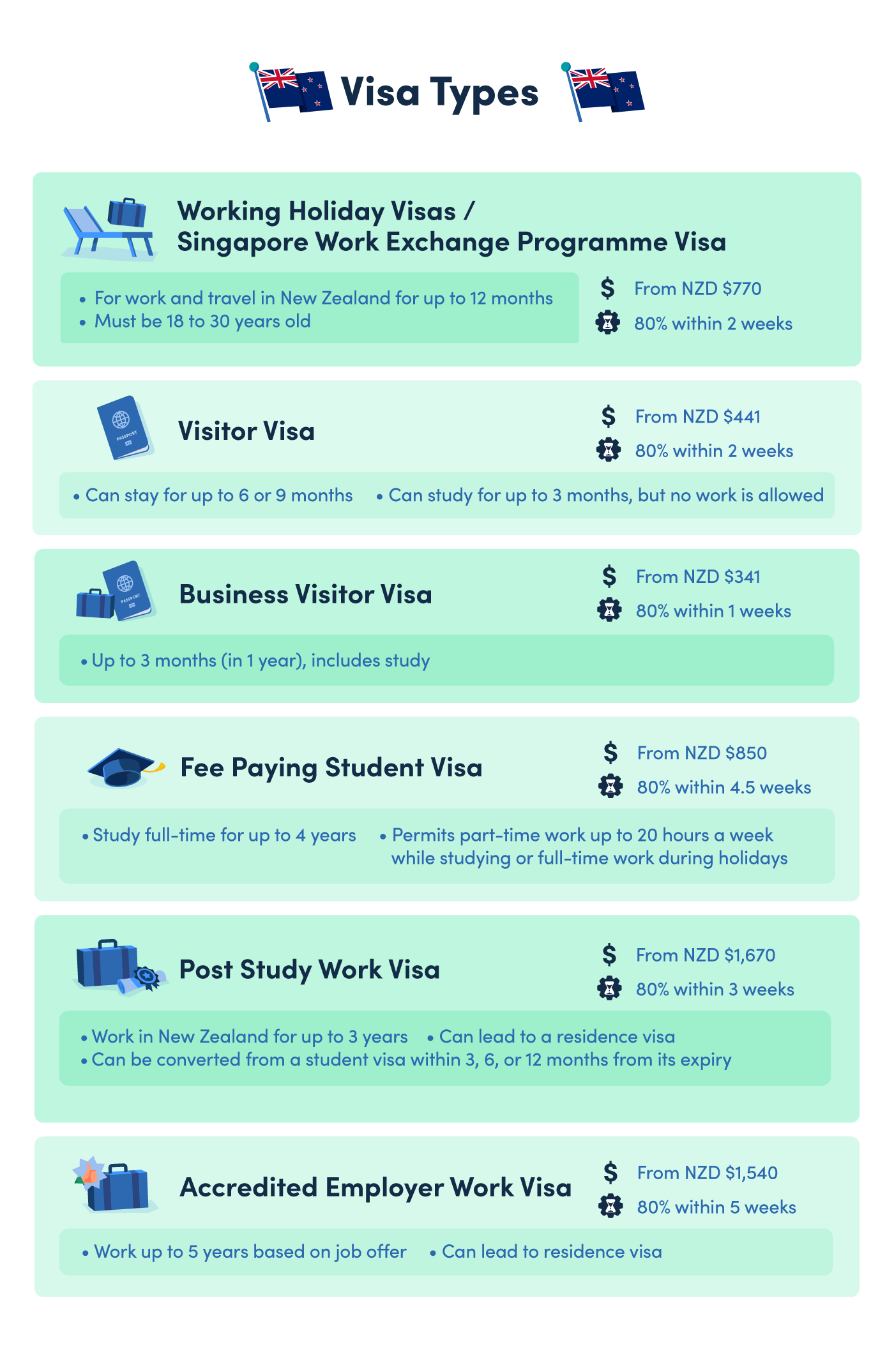
Singaporeans do not need a visa to enter New Zealand, for short stays up to 90 days. However, do note that all travellers to New Zealand, including citizens of visa waiver countries or territories (yes, that includes Singapore!), will need to apply for a valid New Zealand Electronic Travel Authority (NZeTA) instead.
Visa type | Travel purpose & validity | Estimated cost | Processing time |
|---|
Working Holiday Visas / Singapore Work Exchange Programme Visa | Work and travel in New Zealand for up to 12 months Must be 18 to 30 years old | From NZD $770 | 80% within 2 weeks |
Visitor Visa | Can stay for up to 6 or 9 months Can study for up to 3 months, but no work is allowed | From NZD $441 | 80% within 2 weeks |
Business Visitor Visa | Up to 3 months (in 1 year), includes study | From NZD $341 | 80% within 1 week |
Fee Paying Student Visa | Study full-time for up to 4 years Permits part-time work up to 20 hours a week while studying or full-time work during holidays | From NZD $850 | 80% within 4.5 weeks |
Post Study Work Visa | Work in New Zealand for up to 3 years Can lead to a residence visa Can be converted from a student visa within 3, 6, or 12 months from its expiry | From NZD $1,670 | 80% within 3 weeks |
Accredited Employer Work Visa | Work up to 5 years based on job offer Can lead to residence visa | From NZD $1,540 | 80% within 5 weeks |
Source: New Zealand Immigration
Notably while on the Visitor Visa, you are not allowed to work in New Zealand. However, you may be able to work remotely for an employer or client based outside of New Zealand.
MoneySmart Tip
A working holiday visa might be more advantageous than a visitor or standard work visa because it allows you to stay longer, start work immediately, and leave and re-enter New Zealand for unlimited times while the visa is still valid.
| Destination & activities |
|---|
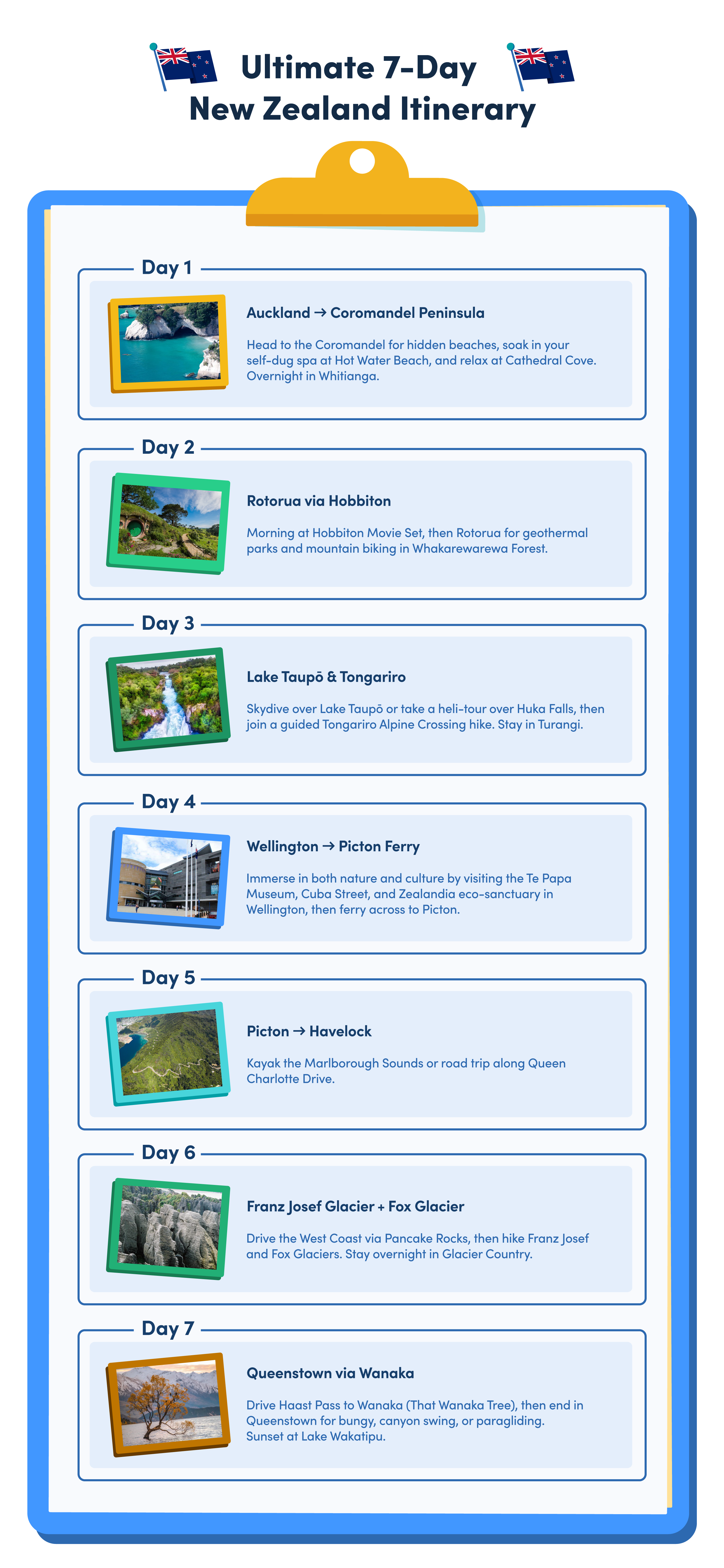
Day 1 | Auckland → Coromandel Peninsula Head to the Coromandel for hidden beaches, soak in your self-dug spa at Hot Water Beach, and relax at Cathedral Cove. Overnight in Whitianga. |
Day 2 | Rotorua via Hobbiton Morning at Hobbiton Movie Set, then Rotorua for geothermal parks and mountain biking in Whakarewarewa Forest. |
Day 3 | Lake Taupō & Tongariro Skydive over Lake Taupō or take a heli-tour over Huka Falls, then join a guided Tongariro Alpine Crossing hike. Stay in Turangi. |
Day 4 | Wellington → Picton Ferry Immerse in both nature and culture by visiting the Te Papa Museum, Cuba Street, and Zealandia eco-sanctuary in Wellington, then ferry across to Picton. |
Day 5 | Picton → Havelock Kayak the Marlborough Sounds or road trip along Queen Charlotte Drive. |
Day 6 | Franz Josef Glacier + Fox Glacier Drive the West Coast via Pancake Rocks, then hike Franz Josef and Fox Glaciers. Stay overnight in Glacier Country. |
Day 7 | Queenstown via Wanaka Drive Haast Pass to Wanaka (That Wanaka Tree), then end in Queenstown for bungy, canyon swing, or paragliding. Sunset at Lake Wakatipu. |
Best seasons to visit New Zealand
Based on the itinerary, the best times to visit New Zealand are summer and autumn. Located deep in the Southern hemisphere, near Antarctica, New Zealand’s summer runs from December to February, while autumn spans March to May.
☀️ Summer (Dec–Feb): Longer daylight, warm water activities, golden-hour opportunities
🍂 Autumn (Mar–May): Cooler temperatures for hiking, wine harvest, autumn foliage, fewer crowds.
MoneySmart Tip
Remember to purchase travel insurance with adventure sports cover to accommodate high-risk activities like bungee jumping, paragliding, white-water rafting, skydiving, hiking, biking, and more!
How to Choose Travel Insurance For Your New Zealand Trip?
Travel insurance isn’t a cookie-cutter deal. Its coverage and scope should match your itinerary, activities, and comfort level. Here’s how to choose the perfect policy for New Zealand, just in case your trip ever takes an unexpected turn.
1. Start with core coverage
At the very least, your travel insurance should cover basics like:
Overseas medical expenses,
Trip disruptions or cancellations, and
Baggage damage, theft, or loss.
In New Zealand, medical care for tourists isn’t subsidised, and treatments at private hospitals can easily run into thousands of dollars. Choose a good insurance plan that covers emergency treatment, hospitalisation, and personal accident costs to ensure you’re not paying out-of-pocket in a crisis.
2. Check policy exclusions
Planning to ski in Queenstown or try white-water rafting in Rotorua?
Most entry-level travel insurance plans don’t include adventure sports cover by default. Read your policy exclusions carefully, and then opt for plans offering an adventure sports rider if your itinerary involves higher-risk activities.
If you have a pre-existing condition (e.g. asthma, diabetes, heart issues), also ensure to opt for plans with PreX (pre-existing condition) coverage—especially for the elderly or those on long-term medication.
3. Consider travel disruption benefits
New Zealand’s weather can be unpredictable with heavy snow, fog, or storms delaying or cancelling flights in winter. Don’t underestimate such weather conditions as they can easily detail even the most carefully planned itinerary.
With that in mind, look for plans that:
Offer fixed payouts per 6- or 12-hour delays
Provide trip curtailment cover in case an emergency forces you to head home prematurely
Includes missed connection benefits for domestic transfers between the North and South Islands
4. Look for digital convenience
In a remote town or on a ski slope, the last thing you want is to fumble with medical paperwork. Choose a policy with a cashless hospital network so bills are paid directly, plus an in-app clinic locator to find nearby care. A 24/7 helpdesk also proves invaluable for emergencies at any hour.
5. Compare premiums
Once you’ve narrowed your shortlisted travel insurance plans, compare premiums carefully against the actual benefits offered. Don’t skimp on key coverage like medical cover or trip disruption protection just to save a few dollars.
Best Travel Insurance For Your New Zealand Trip
Best for | Travel insurance plan | Coverage | Premium |
|---|
Budget travel | MSIG TravelEasy Lite | Up to $50,000 overseas medical expenses Up to $1,000 for baggage damage/loss | From $18.20 |
For pregnancy and families | MSIG TravelEasy Pre-Ex Elite | Up to $2,000 for incidental expenses overseas incurred from pregnancy-related illnesses | From $97 |
Extreme sports and flight disruptions | TIQ Entry | Up to $200,000 overseas medical expenses Up to $5,000 for trip cancellation | From $26.25 |
Pre-existing conditions (especially for elderly) | HL Assurance Travel Protect360 Basic | Up to $150,000 overseas medical expenses | From $25.60 |
Overseas medical expenses | DirectAsia Voyager 500 | Up to $500,000 overseas medical expenses | From $63.94 |
COVID-19 coverage | FWD Premium | Up to $200,000 overseas medical expenses | From $25.80 |
Disclaimer: Figures are accurate as of 19 February 2026 for a 1-week round-trip to New Zealand. Premiums and coverages are subject to change by the insurer, without prior notice.
How Travel Insurance Covers You in Unforeseen Events or Natural Disasters
For context, natural disasters like earthquakes, typhoons, or pandemics can be classified as “known events” once they’ve been publicly reported in the media or flagged by official travel advisories.
Baggage & personal belongings coverage
Some insurers, like Etiqa, even cover baggage loss due to natural disasters (a.k.a. Acts of God), including personal items like laptops or travel documents. Just be aware of exclusions if the disaster was already a known event at the time of policy purchase. Keep an eye on per-item caps, usually ranging between $1,000 and $10,000.
Trip curtailment, cancellation, or travel delay coverage
If your trip is cancelled or delayed due to a disaster, you may claim for non-refundable bookings disrupted by disasters, provided they occur within 30 days of your departure. DirectAsia offers compensation for travel delays, but claim limits vary by provider and are usually capped by per person/family.
Worldwide medical costs coverage
Injured during a natural disaster? Most travel insurance plans cover this under overseas medical expenses. For instance, the FWD First travel insurance plan provides up to $1 million for emergency medical treatment abroad, including outpatient, hospitalisation, surgery, emergency repatriation, and even ambulance or emergency dental service costs where covered.
What is the Average Cost of Travel Insurance to New Zealand?
With so many travel insurance options for New Zealand, choosing the right plan can feel like navigating a Milford Sound fog. To make it easier, here’s a quick cost breakdown of a typical 1-week single-trip travel insurance plan to New Zealand.
Insurer | Overseas medical expenses | Trip cancellations | Baggage damage/loss | Total premiums |
|---|
Allianz Travel | Up to $1 million | Up to $10,000 | Up to $5,000 | From $23.31 |
DirectAsia | Up to $500,000 | Up to $15,000 | Up to $5,000 | From $47.05 |
FWD | Up to $1 million | Up to $15,000 | Up to $7,500 | From $25.80 |
Great Eastern | Up to $1 million | Up to $15,000 | Up to $8,000 | From $24 |
HL Assurance | Up to $750,000 | Up to $15,000 | Up to $8,000 | From $25.60 |
Income | Up to $1 million | Up to $15,000 | Up to $8,000 | From $42.16 |
MSIG | Up to $1 million | Up to $15,000 | Up to $7,500 | From $18.20 |
Singlife | Up to $1 million | Up to $15,000 | Up to $5,000 | From $36.25 |
Sompo | Up to $500,000 | Up to $10,000 | Up to $1,000 | From $42.50 |
Starr | Up to $1 million | Up to $15,000 | Up to $7,500 | From $28.83 |
Tiq by Etiqa | Up to $1 million | Up to $10,000 | Up to $3,000 | From $26.25 |
UOI | Up to $700,000 | Up to $10,000 | Up to $6,000 | From $68 |
Zurich | Up to $500,000 | Up to $7,500 | Up to $5,000 | From $28.44 |
Disclaimer: Figures are accurate as of 19 February 2026 for a 1-week round-trip to New Zealand. Premiums and coverages are subject to change by the insurer, without prior notice.
MoneySmart Tip
Based on the travel insurance plans offered by 13 travel insurers here on MoneySmart, the average cost of a travel insurance plan is $436.39 ÷ 13 = around ~$33.57.
If you’re prioritising affordability, economical options like Tiq by Etiqa, MSIG, FWD, and Starr offer lower premiums yet with decent coverage.
Meanwhile, insurers like Income, Allianz Travel, and Great Eastern offer more extensive coverage from reasonable premiums. They offer plans featuring up to $1 million in overseas medical coverage, up to $15,000 for trip cancellations, and $7,500 to $8,000 for baggage-related claims—making them ideal for travellers valuing both protection and cost-effectiveness.


 Why Trust MoneySmart?
