Renovating a condo in Singapore isn’t just about picking the right tiles or layout—it’s about navigating a tightly regulated framework set by your condo’s Management Corporation Strata Title (MCST). As a condo owner, you’re automatically part of the Management Corporation (MC), a legal entity made up of all unit owners in the development. The MC, often referred to as MCST, oversees everything from estate maintenance to by-law enforcement.
💡 By-law: A rule made by the condo’s MC to regulate the use of both individual units and common property. It can cover things like renovation works, noise limits, pet ownership, and usage of shared facilities. Once passed at a general meeting, all residents must comply, even if they didn’t vote on it.
Because of this, any condo renovation in Singapore—especially in 2026 where trends and costs are evolving—requires careful compliance. You may face restrictions on structural changes, noise, renovation hours, or alterations that affect common property. Planning ahead helps you stay within rules, manage timelines, and avoid costly delays. If you're considering a condo renovation loan, understanding these layers is key to budgeting effectively.
Renovation Differences Between Condos and HDBs
The biggest difference between renovating HDBs and condos lies in ownership and regulations. HDB flats are public housing with standardised guidelines, whereas condos fall under strata-titled private properties. This means condo residents must work closely with the MCST, which governs what’s permissible within the development.
💡 Strata-titled private properties: These are developments like condos where individual owners hold title to their own units, but share ownership of common areas such as corridors, pools, and gyms.
Here’s a summary of the key renovation differences between condos and HDBs:
Aspect | Condo renovation | HDB renovation |
|---|
Ownership type | Private property under strata title | Public housing regulated by HDB |
Regulating body | Managed by MC / MCST, which is formed by unit owners | Overseen centrally by HDB renovation guidelines |
Approval process | Requires written approval from the MC for wet works, hacking, or structural changes | Submit standard permit to HDB for works; generally faster and more standardised |
Design and uniformity | Subject to by-laws—external appearance (e.g. façade, windows) must remain uniform | More interior design flexibility, though some structural works are restricted |
Structural alterations | Hacking of slabs, beams, or columns is prohibited without Professional Engineer advice and Commissioner of Building Control approval | Limited to internal partitions, subject to HDB guidelines |
Renovation hours and noise | Stricter: usually weekdays 9 am–5 pm, no work on weekends or public holidays | More lenient, but noisy works still regulated |
Because of these added layers, condo renovations in Singapore require more rigorous planning, especially when it comes to budgeting and securing approvals.
💡 Commissioner of Building Control: A government-appointed authority under the Building and Construction Authority (BCA) who oversees and approves structural works in buildings—including hacking or alterations to load-bearing elements—to ensure safety and compliance with Singapore’s building regulations.
Common Condo Renovation Challenges

Renovating a condo isn’t just about choosing a design theme—it also means working around several physical and legal constraints.
One key challenge is structural modification. Hacking or altering critical elements like beams, columns, and slabs is not allowed unless assessed by a Professional Engineer and approved by the Commissioner of Building Control. Even wiring works embedded in such structures must be handled by qualified renovation contractors. Failure to follow these steps could compromise your building’s integrity and result in penalties.
Another common obstacle is compliance with MCST by-laws. Condo layouts are often fixed, and wet works like retiling or kitchen upgrades may require written approval. It’s also recommended that you check your Sale and Purchase Agreement for any unit-specific restrictions before starting renovation.
💡 Sale and Purchase Agreement: A legally binding contract between the condo developer and buyer that outlines the terms of the property sale—including the unit's specifications, layout, and any renovation restrictions specific to the development.
Add in restricted working hours, noise rules, and the need to preserve the building’s façade, and it becomes clear that planning your condo renovation in Singapore goes far beyond interior design choices.
Average Condo Renovation Costs in Singapore (2026)
Condo renovation costs in Singapore can vary widely depending on the unit type, whether it’s a new or resale property, and the extent of work involved. According to Qanvast, new condos typically cost between $40,400 and $51,500, while resale units range from $80,800 to $105,000.
A basic makeover might include paint and minor touch-ups, whereas premium upgrades could involve custom carpentry, reconfiguration, and luxury finishes. Below is a breakdown by unit size:
Condo type | Estimated condo renovation cost (2026) |
|---|
1-bedroom | $15,000 to $30,000 |
2-bedroom | $25,000 to $50,000 |
3-bedroom | $40,000 to $60,000 |
4-bedroom | $50,000 to $80,000 |
Source: Hometrust
Cost Breakdown by Key Renovation Elements

The kitchen is one of the most complex areas to renovate in a condo, combining elements like hacking, masonry, carpentry, and plumbing. Whether you're doing a quick upgrade or going all-in with a premium remodel, understanding the cost breakdown by task can help you budget effectively.
For basic upgrades, such as changing a water fixture or redoing one cabinet, costs can be minimal. But more extensive renovations—think full tiling, high-end cabinetry, and reconfiguration of utilities—can cost $14,000 to $61,300 depending on your design choices and finishes.
Here’s a summary of expected costs by renovation element and scope:
Renovation element/scope | Light | Moderate | Extensive |
|---|
Hacking
Fixtures: Cabinets, doors, windows | $100 – $200
Dismantle one fixture | $200 – $900
Partial wall/floor hacking | $900 – $8,800
Full wall/floor hacking + fixture removal |
Masonry
Fixtures: Tiling, base structures | $100 – $900
Basic base build, no tiling | $900 – $3,900
Tiling + cabinet base + waterproofing | $3,900 – $18,600
Full tiling, waterproofing, touch-ups |
Carpentry
Fixtures: Cabinets, worktops | $100 – $5,900
One cabinet with laminates | $5,900 – $8,900
Up to 2 cabinets | $8,900 – $30,600
3+ high-end laminated cabinets |
Plumbing
Fixtures: Sink, tap, piping | $100 – $200
One water fixture | $200 – $300
2–3 fixtures | $300 – $3,300
3+ fixtures, piping reroutes |
Total estimated cost | $400 – $7,200 | $12,000 – $14,000 | $22,000 – $61,300 |
Source: Qanvast
MoneySmart tip
Plan your kitchen layout early. Hacking and plumbing are harder (and costlier) to redo once installed.

Bathrooms are one of the most renovation-intensive areas in a condo, given the layers of work required—hacking, waterproofing, masonry, plumbing, and carpentry. Even basic upgrades like installing a new tap or mirror involve precision, while full remodels require waterproofing, tiling, and fixture relocation.
A light bathroom upgrade may cost under $1,000, but a comprehensive renovation with premium finishes, vanity cabinets, and extended pipework can push costs beyond $12,000. Here’s how the costs break down by renovation element and level of work:
Renovation element/scope | Light | Moderate | Extensive |
|---|
Hacking | $100 – $400 Dismantling one fixture, no hacking of tiles | $400 – $1,300 Dismantling two fixtures, no hacking of tiles | $1,300 – $7,100 Complete hacking of wall and floor tiles |
Masonry | $100 – $3,600 Basic kerb construction, minimal tiling | $3,600 – $7,800 Kerb construction with tiling and waterproofing | $7,800 – $19,500 Comprehensive wet works with full tiling |
Carpentry | $100 – $1,400 Wall-mounted mirror and shelf | $1,400 – $2,300 Mirror and under-sink vanity cabinet | $2,300 – $12,700 Full-height mirror and complete vanity cabinet |
Plumbing | $100 – $700 One water fixture | $700 – $1,200 Two to three fixtures | $1,200 – $7,500 Three or more fixtures with pipe rerouting |
Total estimated cost | $400 – $6,100 | $6,100 – $12,600 | $12,600 – $46,800 |
Source: Qanvast

Renovating your living and dining areas can breathe new life into your condo, whether you're updating a feature wall or reimagining the entire space. These rooms typically involve hacking, masonry, carpentry, and ceiling & partition work. A simple refresh may cost just a few hundred dollars, while a full-scale transformation with custom fixtures and lighting can exceed $60,000.
Here’s a breakdown of renovation costs by element and scope:
Renovation element/scope | Light | Moderate | Extensive |
|---|
Hacking | $100 – $200 Dismantle one fixture, no wall/floor work | $200 – $500 Several fixtures, partial wall/floor hacking | $500 – $6,500 Full hacking of walls/floors, remove all fixtures |
Masonry | $100 – $1,100 Basic appliance/cabinet base | $1,100 – $3,400 Standard base with tiling and touch-ups | $3,400 – $21,500 Comprehensive base with tiling and waterproofing |
Carpentry | $100 – $3,200 1–2 basic home fixtures | $3,200 – $6,300 2–3 regular home fixtures | $6,300 – $25,000 3+ custom home fixtures (e.g., feature wall, bar) |
Ceiling & Partition | $100 – $400 Basic L-box or partition | $400 – $1,200 Partial L-box false ceiling with lighting | $1,200 – $8,500 Full L-box ceiling with lights and enhancements |
Total estimated cost | $400 – $4,900 | $4,900 – $11,400 | $11,400 – $61,500 |
Source: Qanvast

From automating lights to fully integrating climate control and surveillance, smart home upgrades can bring comfort, convenience, and peace of mind to your condo lifestyle.
Here's how the experience—and cost—scales from basic to luxury setups:
Tier | Price range | What’s included | Ideal for |
|---|
Basic | $800 – $1,600 | • Smart plugs & bulbs • Smart door lock • Voice assistant hub • IR controller | First-time adopters seeking convenience & energy savings |
Mid-range | $1,500 – $2,600 | • Programmable lighting • Mesh Wi-Fi • Air-con control or smart thermostat • Security sensors • Smart blinds | Condo dwellers wanting energy efficiency, better security, and smart comfort |
Luxury | $3,700 – $8,700+ | • Full home automation (e.g. Control4) • Multi-room audio • In-wall smart panels • Advanced surveillance • Climate & energy management | Homeowners seeking seamless integration, premium control, and whole-home intelligence |
Source: Home & Decor

Don’t underestimate the difference lighting and electrical systems can make in a home space. Whether you’re enhancing ambience with warm recessed lights or adding new power points for a smart home setup, electrical works form the backbone of both function and aesthetics.
Simple upgrades might involve replacing a few sockets or installing statement pendant lights. But for larger projects—like rewiring, concealed lighting, or creating zones for smart automation—the scope (and cost) grows significantly.
Here’s a quick overview of what you can expect to budget:
Scope | Estimated cost | What’s included |
|---|
Light | $100 – $1,200 | Basic electrical outlets for selected rooms (e.g. bedrooms, study) |
Moderate | $1,200 – $2,700 | Additional outlets and wiring for most living areas |
Extensive | $2,700 – $17,000 | Full electrical rewiring, extra lighting points, wire extensions for major setups |
MoneySmart tip
If you’re also upgrading to a smart home system, it’s best to plan electrical works alongside—this avoids duplicate labour and ensures compatibility for concealed wiring and lighting control.
Condo Renovation Guidelines and Restrictions
Condo renovations in Singapore aren’t just about design inspiration and budgeting—they’re also about compliance. Before any tiles are hacked or cabinets installed, you’ll need to understand the role of the Management Corporation (MCST), what approvals are required, and the legal boundaries for works within your unit.
MCST Approval Process
Before any renovation can begin, homeowners must first seek formal approval from the Management Corporation Strata Title (MCST). The MCST will review your submission to ensure it complies with house rules and by-laws, especially those that affect the building’s appearance or structure. Approval is mandatory before starting work.
Your application will usually involve submitting:
Detailed renovation plans
Work schedules
Contractor information and insurance
Forms or permits specified in the condo’s by-laws
In addition, many condos require a renovation deposit to be placed with the MCST. This is a refundable sum meant to cover potential damage to common property during the renovation period.
If you’re engaging a CaseTrust-accredited renovation contractor, renovation deposits under such contracts are capped at 20% of the total renovation value. This is designed to protect homeowners from overcommitting funds before work begins, while ensuring accountability on both sides.
💡 CaseTrust is a safety mark given to renovation companies by the Consumers Association of Singapore (CASE). It certifies that they follow fair and transparent practices. If you hire a CaseTrust-accredited contractor, your deposit is protected and capped at 20% of the total renovation cost, so you don’t overpay upfront.
Most MCSTs also enforce strict timing regulations, with permitted renovation works typically limited to weekdays between 9 am and 5 pm, and no work allowed on weekends or public holidays to minimise disturbance.
Limitations on Wet Works, Hacking, & External Structures
Not all renovations are created equal. Some works require not just MCST approval but also statutory clearance from the Commissioner of Building Control, especially for:
Hacking of structural elements like beams, slabs, and columns
Relocation of wet areas (e.g. moving the kitchen or bathroom)
Installing false ceilings or making changes that affect load-bearing structures
Even internal wiring and piping that run along structural elements must be handled by licensed professionals, and might require additional engineering assessments.
Some MCSTs also restrict or prohibit:
Adding external awnings, grills, blinds
Modifying window frames or façade features
Roofing over private enclosed spaces (PES)
If any works affect the gross floor area (GFA) or external appearance of the unit, they may require a 90% resolution at a general meeting, or approvals from agencies like URA or BCA.
Renovation Hours and Contractor Access
Renovation hours are usually limited to weekdays from 9 am to 5 pm, with no work allowed during weekends and public holidays to minimise disturbance to residents.
To reduce disruption during early mornings or lunch periods, some MCSTs may limit noisy work (like hacking) to specific hours like 10 am to 4 pm.
MoneySmart tip
Always check your condo’s specific house rules or renovation guidelines before engaging a contractor. These are typically available from the MCST or managing agent.
Financing Options for Condo Renovations in Singapore
Upgrading your condo is exciting, but funding it can be tricky without the right loan. Whether you're planning a full-scale remodel or just replacing fixtures, there are several financing options tailored to renovation needs. Here's a comparison of the main routes available to Singapore homeowners in 2026—renovation loans, personal loans, and credit card instalment plans.
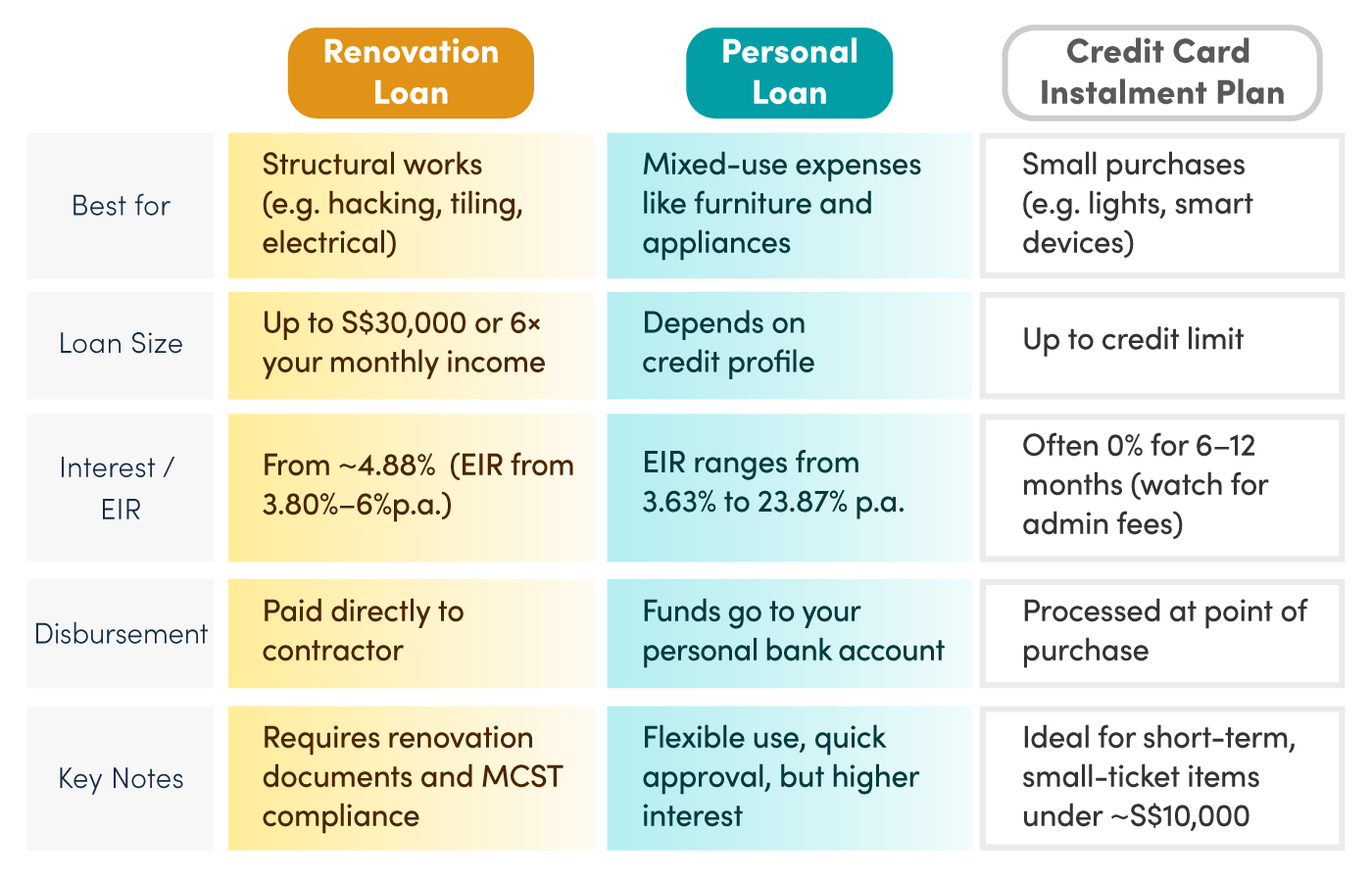
You can also read our other personal loan guides to learn more about where you can use your personal loan.
💡 MoneySmart Tip
Use trusted online comparison tools like MoneySmart's personal loan comparison to review personalised rates, eligibility, and requirements across major banks in Singapore—helping you make a more informed choice quickly.
Loan Repayment Calculator
See how much you need to pay back per month
You can expect to pay:
S$ 2,124.00 / month
*estimated monthly payment
Total cost of loanS$ 50,976.00
Total interestS$ 976.00
Tips to Choose Between Loan Types
Use a renovation loan for heavy works like hacking, tiling, or electrical upgrades.
Choose a personal loan if your renovation includes furniture, décor, or soft furnishings.
For individual purchases (e.g. appliances or feature lights), a credit card instalment plan may offer more value—especially during promo periods.
For all loan options, always compare:
Effective Interest Rate (EIR), not just the advertised rate
Total repayment over the loan tenure
Processing fees and disbursement terms
Tips to Renovate a Condo Smartly in 2026
The most successful condo renovations are all about making smart decisions that keep your renovation compliant, cost-effective, and long-lasting. Here are expert-backed strategies to help you spend wisely while getting the most out of your upgrade.
Work with Condo-Experienced Contractors
Not all renovation firms are familiar with condo-specific rules, like MCST approvals or hacking limitations. Choosing a contractor who regularly handles condo projects helps avoid costly delays or rejected works.
Better yet, look for those CaseTrust-accredited. These firms follow transparent pricing, are trained to manage disputes, and limit upfront deposits to no more than 20%—offering homeowners greater peace of mind.
Align Design with Layout and Natural Light
Instead of over-renovating, work with what your unit already offers. Smart condo layouts maximise space, so focus on clever storage, open-plan flow, and letting in as much natural light as possible.
For example:
Use glass partitions instead of walls to open up sightlines
Opt for light-toned finishes to brighten dark corners
Place mirrors strategically to reflect light and expand visual space
Renovate in Phases if Budget Is Tight
A full renovation can be overwhelming and expensive. If you're working within a tighter budget, consider doing your condo in phases, prioritising wet areas and high-traffic zones:
Phase 1: Wet areas (kitchen, bathroom) – these are harder to redo later
Phase 2: Flooring and built-ins
Phase 3: Soft furnishings and feature walls
This lets you prioritise high-use areas and spread out your spending without compromising quality.
Ask for Transparent Quotes & Avoid Hidden Costs
Always request a detailed breakdown of your renovation quote. Don’t just look at the grand total—ask about commonly overlooked costs like:
Haulage fees
Debris removal and disposal
GST (Goods & Services Tax)
MCST renovation deposits or administrative fees
Permit or approval charges
These can add up quickly and surprise unprepared homeowners. You should get at least 2–3 quotes, and don’t be afraid to ask contractors to explain line items in plain terms. This is the time you should ask as many questions as you have.


 Why Trust MoneySmart?
 (1).png)