Why Landed Property Renovations Require Special Planning
Renovating a landed home in Singapore is vastly different from upgrading a flat or condo. With more space, greater structural freedom, and tighter regulations, planning becomes more complex—and often pricier.
Unlike strata-titled properties, landed homes allow extensive exterior and structural changes. This flexibility comes with added responsibilities, including compliance with Urban Redevelopment Authority (URA) and Building and Construction Authority (BCA) guidelines, including height restrictions, setback rules, and drainage requirements.
Landed property renovation also involves bigger budgets and longer timelines. Whether it’s an interior facelift or major structural works, each project requires coordination with architects, contractors, and occasionally government agencies. The stakes are higher, so smart planning is key to ensuring lasting value and regulatory compliance.
Looking to renovate an HDB flat or condo instead? Check out our renovation cost and loan guides for HDB flats and condominiums.
Renovation vs. rebuilding: What’s the difference?
In landed homes, major upgrades fall into two broad categories: Additions & Alterations (A&A) and Reconstruction.
Category | Additions & Alterations (A&A) | Reconstruction |
|---|
Scope of work | Modifying existing structure: room extensions, attic addition, beam replacement | Complete teardown or major rebuild beyond A&A limits |
Gross Floor Area (GFA) limit | Changes must not exceed 50% of GFA | Exceeds 50% of GFA |
Structural changes | Max 50% of structural components or external walls | More than 50% structural changes; full rebuild |
Roof modifications | Full roof replacement allowed, no additional storey added | Involves increase in storeys or roof changes that add a new floor |
Housing form changes | Not allowed | Includes change in dwelling type (e.g. semi-D to bungalow) |
Approval Required | BCA submission and URA planning permission may be required | Requires fresh URA planning approval and BCA structural clearance |
Cost and timeline | Faster and more cost-effective | Higher cost and longer timeline |
Best For | Light-to-moderate upgrades with minimal structural impact | Full redesign, long-term plans, or ageing properties needing total transformation |
Common reasons for renovating landed properties
Landed homes are prized for their space and long-term value, but they often require updates to stay functional and appealing. Many homeowners renovate to expand their living areas, especially as multi-generational living becomes more common. Others focus on revamping outdated interiors—modernising bathrooms, kitchens, and common areas for better usability and aesthetics.
External upgrades are equally popular. Improving the façade or roofing can significantly boost curb appeal, while landscape improvements elevate both comfort and value. In some cases, the goal is to improve layout efficiency—breaking down walls for open-plan concepts or improving ventilation and natural light. Increasingly, renovations are also about integrating smart home technology or meeting green standards.
Whatever the reason, landed property renovations in Singapore must balance creativity with compliance—turning bold ideas into legal, liveable realities.
Average Renovation Costs for Landed Properties in Singapore (2026)
Renovating a landed property in Singapore doesn’t come cheap. With more floor area, customisation, and compliance requirements, costs are typically much higher than for condos or HDB flats. However, the range of renovation prices can vary widely depending on factors like property type (terrace, semi-detached, or bungalow), the extent of the works, and material choices.
According to OMY Singapore, landed renovation projects typically cost anywhere between $100,000 to over $300,000. Meanwhile, Coohom estimates that renovating a terrace house in Singapore—typically the smallest type of landed property—can range from $50,000 to $200,000, depending on scale and design preferences. We can expect costs for semi-detached houses and bungalows to be even higher. These broad figures highlight how renovation cost in Singapore in 2026 can differ significantly across different projects.
To offer more structured guidance, TCA Think Tank Design & Build outlines three typical cost tiers for landed property renovation in Singapore:
Renovation scope | Estimated cost range | What’s included |
|---|
Minor refresh | $10,000 – $30,000 | Cosmetic updates like painting, new flooring, lighting, and small appliance changes. |
Mid-range renovation | $50,000 – $100,000 | Kitchen or bathroom remodelling, cabinetry work, and mid-tier finishes. |
Comprehensive makeover | $200,000 and above | Full-house renovation with structural works, layout reconfiguration, and premium materials. |
Your actual landed property renovation cost in Singapore will depend heavily on your scope. For instance, structural changes may require planning permission from URA and plan submission to BCA, along with involvement from a Qualified Person (QP). This adds to the timeline and budget.
💡 A Qualified Person (QP) is a registered architect or professional professional civil or structural engineer authorised to submit renovation plans and ensure compliance with URA and BCA regulations. QPs are legally required for structural works, rebuilds, and projects involving major layout changes.
Landed property renovation cost breakdown by component
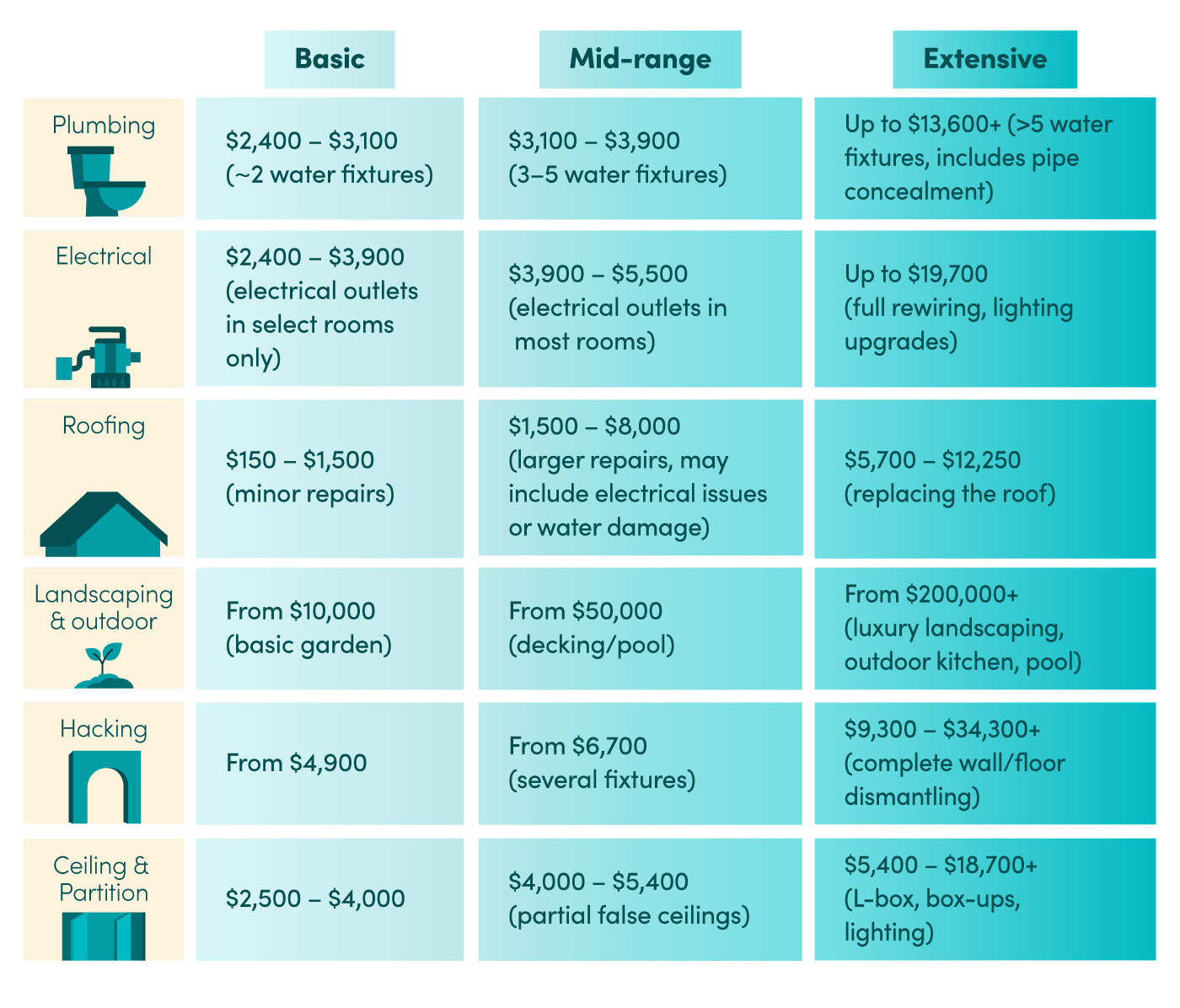
Renovation budgets for landed properties aren’t just about the big picture—they’re made up of multiple specialised works that can quickly add up. Below is a breakdown of typical cost ranges across several major renovation categories:
MoneySmart tip
Always itemise your budget before starting works. Costing out each scope, like rewiring, tiling, or landscaping, will give you a better handle on your finances and help you prioritise based on need versus nice-to-have.
Key Factors Affecting Pricing of Landed Property
Renovation costs for landed properties in Singapore can swing widely depending on several key elements—from the size of the home to the ambition of the design. Unlike HDBs or condos, landed homes come in various layouts and conditions, so pricing is far less predictable and far more sensitive to scope and finish. Below, we break down the 2 biggest cost drivers: price per square foot and influencing variables.
Renovation costs per sqm: $300 – $700+
A quick way to estimate landed renovation costs is by calculating the price per square foot (psf). This method is especially useful for full-scale remodels or rebuilds.
Standard finishes: $300 to $400 psf
Think basic tiling, laminate cabinets, quartz countertops, and conventional lighting. Suitable for homeowners prioritising functionality over flair.
Premium finishes: $450 to $700 psf
Includes imported marble, smart lighting, designer carpentry, and high-end fittings—often seen in luxury rebuilds or modern landed transformations.
Your final psf rate depends not only on finish level but also on structural complexity, whether you’re making major layout changes, and the overall scale of the project.
MoneySmart tip
Always ask contractors for a detailed cost breakdown by psf category. This helps identify where your money is going and gives you leverage for negotiation—especially if comparing multiple quotes.
Factors influencing total cost
Beyond just square footage, these underlying factors can significantly shape your renovation bill:
Age of the property: Older homes may require rewiring, plumbing upgrades, or asbestos removal.
Design ambition: A minimalist Scandinavian theme is generally more cost-effective than a luxury look with imported tiles and custom metalwork.
Material choice: Premium materials like marble, solid wood, and designer fittings can multiply your costs compared to vinyl flooring or off-the-shelf fixtures.
Contractor tier and project model: Reputable contractors and design-and-build firms have project management expertise, but often charge more. Freelance contractors may be cheaper but require closer supervision.
Can I Take a Loan to Renovate a Landed Property?
Loan Repayment Calculator
See how much you need to pay back per month
You can expect to pay:
S$ 2,124.00 / month
*estimated monthly payment
Total cost of loanS$ 50,976.00
Total interestS$ 976.00
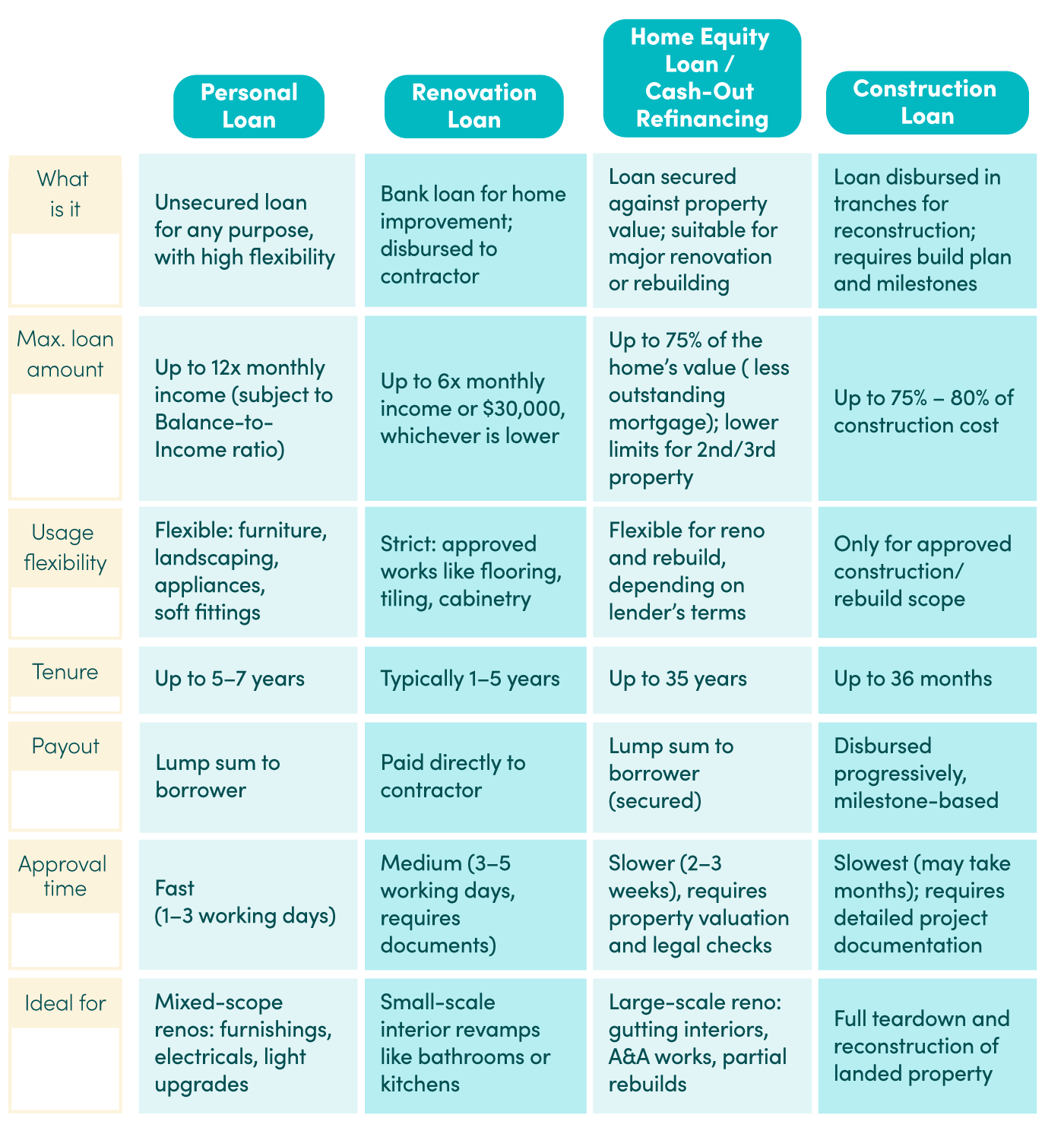
Yes, you absolutely can—but the right financing option depends on the scale of your project and whether you're doing minor upgrades, a full makeover, or a total rebuild. Here’s a breakdown of the four main types of loans suited for landed renovations in Singapore:
Personal Loans: Unsecured loans with higher limits and flexible use—ideal for mixed-scope renovations.
Renovation Loans: Structured for home improvements, but with lower caps and usage restrictions.
Home Equity Loans: Only available for private property or executive condos after their 5-year MOP, these loans tap into your home’s value to finance large projects with longer repayment periods.
Construction Loans: Designed for rebuilds; released in stages and tied to construction milestones.
READ: Personal Loan vs Renovation Loan: Which is Better for Home Improvement?
💡 MoneySmart Tip
Use trusted online comparison tools like MoneySmart's personal loan comparison to review personalised rates, eligibility, and requirements across major banks in Singapore—helping you make a more informed choice quickly.
Loan comparison for landed property renovations
MoneySmart tip
If you're planning to renovate in stages, consider layering your financing—use a renovation loan for fixed works, a personal loan for furnishings, and home equity if you need flexibility for major works.
Legal, Regulatory & Approval Considerations
Unlike HDB or condominium upgrades, landed property renovations—especially those involving structural changes—come under close scrutiny from multiple government agencies. From setbacks to structural integrity, approvals must be secured to avoid costly rectifications, delays, or penalties. Here’s what you need to know before picking up a sledgehammer.
URA regulations & GFA (Gross Floor Area) guidelines
The URA governs development controls for landed homes, and any Additions & Alterations (A&A) or reconstructions must comply with the following:
GFA Limit: A&As cannot exceed 50% of the existing approved Gross Floor Area (GFA). Beyond this, your project becomes a reconstruction with stricter controls.
External Walls: Replacing over 50% of external walls also counts as reconstruction.
Structural Changes: Works like adding columns or floor slabs should stay under 50% of the existing building’s structure to remain within A&A scope.
Roof Modifications: Changing the entire roof or adding an attic is allowed within A&A—but must not result in an extra storey.
Building Envelope: For older landed homes, even compliant A&A works must not further exceed URA’s current envelope control guidelines.
💡 Envelope control refers to URA’s guidelines that define the maximum allowable building height, width, and depth for landed homes. It ensures that new works stay within a controlled “building envelope” to maintain neighbourhood character and avoid overbuilding.
Submission of renovation plans to authorities
The Building and Construction Authority (BCA) requires most structural works to be submitted for approval. However, some minor or “insignificant building works” (e.g., small tiling jobs or non-structural internal partitions) may be exempt.
Typical authorities and clearances involved include:
BCA – for building plans, especially if structural modifications are involved
SCDF – for fire safety compliance if installing features like external staircases or large windows
NEA – for works that may impact drainage, waste systems, or environmental health
Plans must be submitted through a Qualified Person (QP)—either a Registered Architect (RA) or Professional Engineer (PE). They are responsible for ensuring your proposed works comply with regulatory frameworks and obtaining all necessary permits.
Working With Licensed Architects & Structural Engineers
If your landed renovation involves structural elements—such as beams, foundations, columns, or external extensions—engaging a licensed QP is mandatory. This is especially true for:
Adding new floors or attics
Removing structural walls
Enlarging the kitchen, bathrooms, or external patios
Changing façade materials with weight-bearing implications
A Registered Architect typically oversees design compliance and submissions to URA, while a Structural Engineer ensures load-bearing safety and endorses plans submitted to BCA.
MoneySmart tip
Choose QPs who specialise in landed housing. They’re more familiar with envelope control rules and neighbourhood-specific zoning nuances, which can smoothen the approval process significantly.
Tips to Manage Large-Scale Landed Renovations
Handling a full landed renovation—or an outright rebuild—is not just about style and floorplans. With multiple trades, approvals, and timelines to juggle, large-scale projects can quickly become overwhelming without the right systems in place. Here are 4 key strategies to stay in control of your project from start to finish.

Hiring a design-and-build firm means consolidating all key services—architecture, design, engineering, project management, and construction—under one roof. This model reduces miscommunication between stakeholders and speeds up decision-making.
It’s especially useful for rebuilds or major layout changes where planning approvals, BCA submissions, and construction must be closely coordinated.

Always obtain at least 3 quotes—and ensure they are based on similar specifications. Cheaper isn’t always better; it may signal missing scope, lower material quality, or poor aftercare.
Ask to see project portfolios of past landed works. A reputable contractor should have experience handling GFA compliance, elevation drawings, and URA submissions.

Large-scale projects should follow a phased payment schedule tied to clear progress points. Here’s a sample payment schedule:
Renovation payment milestones | Percentage of cost |
|---|
Deposit | 10% |
Hacking and demolition | 15% |
Masonry and concrete | 15% |
Carpentry | 15% |
Electrical works and plumbing | 15% |
Painting and debris clean-up | 15% |
Customer’s final approval | 15% |
Source: PropertyGuru
Each stage should be verified by your QP or project manager before you release payment. Never agree to 50% upfront or lump-sum disbursements without progress checks.

Even the most meticulously planned renovation can encounter setbacks—from permit delays and rising material costs to unexpected foundation or drainage issues.
A 10–20% contingency fund cushions your budget and ensures works aren’t halted midway. This buffer is particularly critical for older landed homes where structural surprises are more likely.
MoneySmart Tip
Read our other personal loan guides to learn more about where you can use your personal loan.


 Why Trust MoneySmart?
 (1).png)