Life Insurance vs Health Insurance: Should You Get Them?
Life insurance and health insurance are like two sides of the same coin: they both provide financial protection but serve distinct purposes. With Singapore’s rising life expectancy, some might prioritise health insurance while viewing life insurance as less essential—but is that really the case?
Do we still need both types of insurance coverage, or is one more crucial than the other? Let’s examine the key differences between life insurance and health insurance, and determine if it’s sensible for your financial security and health in Singapore today.
Do we still need both types of insurance coverage, or is one more crucial than the other? Let’s examine the key differences between life insurance and health insurance, and determine if it’s sensible for your financial security and health in Singapore today.
Disclaimer: This page is meant for educational purposes only and is not meant to be taken as personalised financial advice. Please consult with a trusted professional before purchasing any insurance plan.

Unbiased Advice
No hard selling, ever

~90mins
Quote delivered to you

⭐⭐⭐⭐⭐ Rated 4.4/5
1.900+ reviews on Google
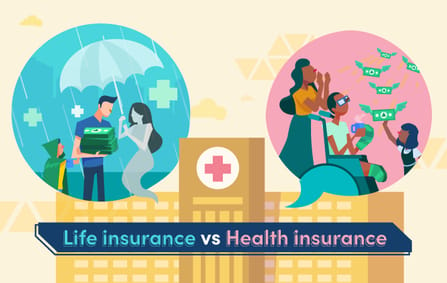
Table of Contents
Click to jump to these sections:
What is Life Insurance? And What Does it Cover?
Life insurance provides lasting financial protection by offering a death benefit to beneficiaries in case of the policyholder’s (your) death or Total and Permanent Disablement (TPD). Financial security provided during this crucial time includes covering funeral expenses, existing debts (if any), and other living expenses to continue supporting the family.
Within the life insurance umbrella, there are 2 main types: whole life insurance and term insurance. While there are distinctions, both life insurance types still primarily cover for death, terminal illness, and TPD.
Within the life insurance umbrella, there are 2 main types: whole life insurance and term insurance. While there are distinctions, both life insurance types still primarily cover for death, terminal illness, and TPD.
Whole Life Insurance
As its name suggests, whole life insurance provides lifelong financial protection, as long as premiums are paid and the policy remains active. It’s available in 3 types: participating plans, non-participating plans, and investment-linked policies (ILPs).
Participating plans: Share profits from insurer’s participating fund through non-guaranteed bonuses or dividends, in addition to the sum assured.
Non-participating plans: Only offers a guaranteed sum assured and cash value, without any optional or additional bonuses or dividends.
ILP: Combines life insurance and investment,where premiums are used to purchase units in investment-linked sub-fund(s). Investment returns, distributed as cash value, fluctuate based on sub-fund performance.
Sum assured: Refers to a guaranteed payout to beneficiaries upon the policyholder’s death or TPD.
Cash value: Refers to the savings component that accumulates over time through premiums paid and/or bonuses. Depending on the nature of the policy, cash value may be withdrawn or liquidated when needed.
Regardless of plan type, all whole life insurance policies provide a guaranteed sum assured and accumulated cash value. However, only participating plans will receive additional, non-guaranteed bonuses or dividends, whereas non-participating plans will not.
| Whole life insurance | Participating plan | Non-participating plan | ILP |
|---|---|---|---|
| Sum assured | Yes | Yes | Yes |
| Cash value | Yes | Yes | Yes |
| Dividends/bonuses | Yes | No | No |
Regardless of plan type, all whole life insurance policies provide a guaranteed sum assured and accumulated cash value. However, only participating plans will receive additional, non-guaranteed bonuses or dividends, whereas non-participating plans will not.
Term Insurance
On the other hand, term insurance provides shorter-term financial protection, over a fixed period ranging between 5 to 40 years. Unlike whole life insurance, it does not offer any cash value. It only provides the death benefit or TPD payout if it occurs during the policy term.
It’s available in either fixed or decreasing coverage, affecting the sum assured and premium amounts.
Fixed coverage: Sum assured remains the same throughout policy term.
Decreasing coverage: Sum assured gradually decreases over time until it reaches zero at the end of term. Typically used for housing loans or other debts.
Renewable: Policy can be extended once expired, but premiums may increase and are not guaranteed.
Convertible: Policy can be converted into another type of insurance like whole life, endowment, or ILP, but requires certain conditions to be met.
Riders may be added to enhance its coverage benefits. Due to its shorter tenure, premiums are also relatively cheaper than life insurance plan types.
It’s available in either fixed or decreasing coverage, affecting the sum assured and premium amounts.
Riders may be added to enhance its coverage benefits. Due to its shorter tenure, premiums are also relatively cheaper than life insurance plan types.
Endowment plans
An endowment plan is a hybrid financial product that combines insurance protection, savings, and sometimes investment returns, into one. More commonly, it is marketed as a savings insurance plan designed to help you work towards financial goals, such as a child’s education fund or retirement planning.
Like most life insurance policies, endowment plans are no different; a lump sum payout is given out either upon policy maturity, at pre-specified intervals, or upon policyholder’s death, whichever comes first. Moreover, most endowment plans accumulate a cash value over time, which varies across plan type and tenure.
Similar to whole life insurance, they also come in two main variants.
Participating endowment plan: Premiums paid are pooled together and invested in the insurer’s participating fund. Profits depend on the fund's performance, distributed as non-guaranteed dividends or bonuses. When a claim is made or the plan matures, these bonuses or dividends will be declared and be paid on top of the guaranteed sum assured.
Non-participating endowment plan: Consists of guaranteed lump sum payout (sum assured) and cash values, without any exposure or returns from market performance.
Like most life insurance policies, endowment plans are no different; a lump sum payout is given out either upon policy maturity, at pre-specified intervals, or upon policyholder’s death, whichever comes first. Moreover, most endowment plans accumulate a cash value over time, which varies across plan type and tenure.
Similar to whole life insurance, they also come in two main variants.
Investment-Linked Policies (ILPs)
An Investment-linked policy (ILP) combines life insurance coverage with an investment component. Premiums paid are allocated to purchase units in selected sub-funds. Thereafter, some of these units are sold to cover the cost of insurance and related fees, while remaining units continue to grow within the investments.
Depending on the policy’s nature, the death or TPD benefit may consist of either:
The higher of the sum assured, or
The value of units in the sub-fund, or
Combination of the two.
While most advise erring on the side of caution before proceeding with ILPs, they remain fairly popular due to their flexibility. For instance, policyholders can easily switch sub-funds, top up investments, and partially withdraw when needed.
An ILP is a valuable option if your basic life insurance coverage is already accounted for and you’re looking for additional coverage with an investment component. That said, everyone’s needs differ, so it’s important to consult your financial advisor to determine the best approach for your health and financial protection.
Depending on the policy’s nature, the death or TPD benefit may consist of either:
While most advise erring on the side of caution before proceeding with ILPs, they remain fairly popular due to their flexibility. For instance, policyholders can easily switch sub-funds, top up investments, and partially withdraw when needed.
An ILP is a valuable option if your basic life insurance coverage is already accounted for and you’re looking for additional coverage with an investment component. That said, everyone’s needs differ, so it’s important to consult your financial advisor to determine the best approach for your health and financial protection.

What About Additional Life Insurance Riders?
Whether term or whole, life insurance comes with a wide range of optional riders to enhance your plan’s coverage scope—sometimes as many as 5 to 10 riders per plan—which can be overwhelming for those unfamiliar. Unlike health insurance, where riders mainly remain to reduce out-of-pocket costs, life insurance riders serve diverse purposes to enhance financial protection and security for both family and policyholder.
There are 5 main types of life insurance riders in Singapore:
*Some life insurance plans might be voided once the critical illness payout is activated. You will no longer be eligible for the original life insurance payout.
There are 5 main types of life insurance riders in Singapore:
| Life Insurance Rider | What It Is | How It Helps |
|---|---|---|
| Total Permanent Disability (TPD) | Receive sum assured if diagnosed with TPD. | Supports policyholder and family, especially if the policyholder was the sole/main breadwinner. |
| Accidental Death | Provides additional payout in case of policyholder’s accidental death. | Helps family cope with financial loss. |
| Critical Illness / Accelerated Death | Extends life insurance payout to cover critical illness diagnoses (e.g., heart attack, terminal cancer). | Provides a lump sum payout for financial support upon diagnosis. |
| Premium Waiver | Excuses policyholder from paying premiums under certain circumstances (e.g., critical illness diagnosis). | Ensures continued coverage without financial burden. |
| Income Benefit / Family Income | Provides regular monthly income for a predetermined period after policyholder’s death or TPD diagnosis. | Ensures financial stability and peace of mind for loved ones during difficult times. |
*Some life insurance plans might be voided once the critical illness payout is activated. You will no longer be eligible for the original life insurance payout.
Best Life Insurance Plans in Singapore

Don’t Leave Life Up to Chance
While we can’t control the future, we can still take proactive steps to prepare for the worst. Compare the best term and whole life insurance plans with us to find the right coverage for you and your family’s needs.
What is Health Insurance? And What Does it Cover?
In a nutshell, health insurance is used to offset healthcare costs like hospital bills and treatments incurred from illnesses, injuries, or disability. As part of Singapore’s social security system, all Singaporeans and PRs are covered under the government’s universal health insurance scheme, MediShield Life.
As the most basic form of health insurance, MediShield Life offers lifelong coverage for significant medical or hospital bills during your recovery. The payouts provided aren’t affected by age or health condition, covering a portion of your medical expenses or being pegged at B2/C class hospital wards if you’re hospitalised.
For hospital ward upgrades (to A/B1 class) or private hospital visits, MediShield Life will only be able to cover a small portion of the bill. The remaining costs will need to be paid using MediSave or cash. Furthermore, there are limits on the claim amount. For example, certain cancer drug treatments can only be reimbursed between $200 to $9,600 per month, depending on the treatment type.
In total, there are 6 main types of health insurance plans in Singapore:
As the most basic form of health insurance, MediShield Life offers lifelong coverage for significant medical or hospital bills during your recovery. The payouts provided aren’t affected by age or health condition, covering a portion of your medical expenses or being pegged at B2/C class hospital wards if you’re hospitalised.
For hospital ward upgrades (to A/B1 class) or private hospital visits, MediShield Life will only be able to cover a small portion of the bill. The remaining costs will need to be paid using MediSave or cash. Furthermore, there are limits on the claim amount. For example, certain cancer drug treatments can only be reimbursed between $200 to $9,600 per month, depending on the treatment type.
In total, there are 6 main types of health insurance plans in Singapore:
| Type of Health Insurance | What It Is | How It Helps |
|---|---|---|
| MediShield Life | Basic form of healthcare available to Singaporeans and PRs. | Covers significant hospital bills, select outpatient treatments, and hospitalisation (up to class B2/C wards). |
| Integrated Shield Plans (IPs) | Additional rider offered by private insurance companies. | Enhances MediShield Life coverage; covers costs of higher ward classes (A/B1 class) or private hospitals. |
| Hospital Cash Insurance | Receive a fixed amount of allowance per day while hospitalised. | Covers daily costs or unexpected expenses such as out-of-pocket medical treatments, transport, or other costs. |
| Critical Illness Insurance | Receive a one-time lump sum when diagnosed with a critical illness. | Provides financial flexibility to use the funds as needed. |
| Disability Income Insurance | Replaces income when you become disabled or no longer able to work. | Financially supports family and self, especially if you were the sole/main breadwinner. |
| CareShield Life | Covers long-term costs of severely-disabled Singaporeans. | Provides lifelong protection and assurance, even after fully paying all premiums by age 67 or 10 years after joining, whichever is later. |
Best Health Insurance Plans in Singapore



Don't Gamble With Your Health
Health is too precious to take chances with; Safeguard your health against any unexpected illnesses with the right policy. Compare the best health insurance plans with us and find the best coverage for you and your loved ones today!
What’s the Difference Between Life Insurance and Health Insurance?
While we’ve elaborated plenty on what life insurance and health insurance are, how exactly do they differ from each other? What aspects should we consider?
Purpose of insurance plan
Life insurance provides a lump sum payout (sum assured), along with other non-guaranteed or optional benefits depending on plan type, to tide over your family’s financial situation in the event of the policyholder’s (your) death or TPD.
Meanwhile, health insurance covers the medical costs, treatments, medication, and hospitalisation expenses incurred from injuries, illnesses, or disabilities.
Meanwhile, health insurance covers the medical costs, treatments, medication, and hospitalisation expenses incurred from injuries, illnesses, or disabilities.
Cost of insurance premiums
Life insurance premiums vary, depending on the policyholder’s age, health, lifestyle, and the sum assured (coverage amount). Moreover, premiums may remain fixed or increase accordingly. But in general, term insurance tends to offer more affordable premiums.
Health insurance premiums are also determined by factors like age, health condition, coverage scope, and medical history/exclusions. However, they are considered typically affordable, but can increase with age or medical needs.
Health insurance premiums are also determined by factors like age, health condition, coverage scope, and medical history/exclusions. However, they are considered typically affordable, but can increase with age or medical needs.
Coverage duration
Life insurance coverage can either last a lifetime (whole life) or for a specified period (term life) while health insurance provides coverage until healthcare needs are met. Either way, both plans require premiums to be continuously paid.
Target beneficiaries
Life insurance beneficiaries usually comprise family members, spouse, or other dependents relying on the policyholder for financial support.
In contrast, health insurance beneficiaries typically pertain to the policyholder (and their medical expenses).
In contrast, health insurance beneficiaries typically pertain to the policyholder (and their medical expenses).
Types of expenses covered
Life insurance covers death, terminal illness, and TPD. Riders such as critical illness or accidental death may be added for broader coverage.
Health insurance covers all things healthcare cost-related, including hospitalisation, medical bills, outpatient care, specific medical treatments, and more.
Health insurance covers all things healthcare cost-related, including hospitalisation, medical bills, outpatient care, specific medical treatments, and more.
Potential exclusions
Life insurance may exclude suicide within first few years of coverage, death induced by criminal activity, or select pre-existing conditions.
Health insurance may exclude pre-existing medical conditions, along with high-risk activities, cosmetic procedures, or other unrecognised non-medical treatments.
Health insurance may exclude pre-existing medical conditions, along with high-risk activities, cosmetic procedures, or other unrecognised non-medical treatments.
Claim limits
The lump sum payout (sum assured) of life insurance is fixed throughout, regardless of medical or other expenses incurred.
The coverage limit for health insurance varies according to medical treatment, hospitalisation fees, and other factors. For example, cancer drug treatment has varying capped reimbursement amounts.
The coverage limit for health insurance varies according to medical treatment, hospitalisation fees, and other factors. For example, cancer drug treatment has varying capped reimbursement amounts.
Investment components
Certain life insurance policies can involve investments such as investment-linked policies (ILPs). Premiums are used to purchase units in selected sub-funds, allowing you to grow savings over time while still maintaining some insurance coverage.
Health insurance does not usually involve any investment component. It’s purely focused on medical expenses and healthcare-related costs.
Health insurance does not usually involve any investment component. It’s purely focused on medical expenses and healthcare-related costs.
How to Choose the Right Insurance For Your Needs?
While both life insurance and health insurance are essential financial tools safeguarding against life uncertainties, their importance varies based on your personal circumstances. To rehash, life insurance typically provides a lump sum payout (sum assured) in the event of death or TPD, whereas health insurance primarily focuses on covering medical and hospitalisation expenses.
To determine which insurance type is more relevant for your needs, here are a few questions to consider and get the ball rolling:
These are valuable questions for both personal introspection and directed as discussions with your financial advisor, helping you determine which type of insurance—life or health—is more crucial for your current stage in life.
To determine which insurance type is more relevant for your needs, here are a few questions to consider and get the ball rolling:
| What to Ask Yourself? | If Life Insurance | If Health Insurance |
|---|---|---|
| What are your primary goals? | Do you prioritise financial security for loved ones in the event of your death or TPD? | Are you more concerned with medical expenses and hospital bills? |
| What is your current health status? | Are you worried about leaving behind debt or other financial burdens if you were to die or suffer from TPD? | Do you have any existing health conditions that require regular treatment or hospitalisation? |
| What is your financial situation? | Will your family be financially secure when you’re no longer around? | Can you afford lifelong premiums for more comprehensive health coverage? Or are you satisfied with just basic health coverage (i.e. MediShield Life)? |
| Are you looking for investing components? | Do you prefer a plan that combines life coverage with investing elements (i.e. ILPs)? | Do you need investment mixed with medical coverage? |
| What’s your current lifestyle? | Are you the main breadwinner of the household or at least, have dependents to support under you? | Do you have a low-risk or high-risk lifestyle that requires specialised health coverage, especially if you’re active in sports or adventurous activities? |
| Do you already have sufficient coverage through other policies? | Do you have enough existing life insurance coverage? Or do you need add-ons (e.g. in the form of a rider like IPs)? | Is MediShield Life or your company’s health insurance enough for your coverage needs? |
These are valuable questions for both personal introspection and directed as discussions with your financial advisor, helping you determine which type of insurance—life or health—is more crucial for your current stage in life.
About the Author

Once a clueless Z-llennial herself, Emma understands (and relates) all too well the struggle of juggling savings, credit cards, and everything in between. Having since garnered over 3 years of writing experience in the personal finance space, she now helps others sieve through the noise and break down money matters into clear, bite-sized insights.
Frequently Asked Questions
Is life insurance the same as health insurance?
- No, life insurance and health insurance are not the same. Life insurance focuses on providing financial support in the form of a sum assured to the policyholder’s family in the event of their death or TPD whereas health insurance covers significant medical costs, treatment plans, hospitalisation bills, and more.
I already have MediShield Life and/or CareShield Life. What kind of health insurance would I still need?
- It depends on your coverage preferences and financial situation. If the basic coverage afforded by MediShield Life and/or CareShield Life is enough for your current life stage, health status, you may not require additional health insurance right away.
But if you anticipate needing greater financial protection or higher healthcare costs due to specifical medical conditions, private hospital preferences, or other reasons, you may consider acquiring other health insurance plans like Integrated Shield Plans, hospital cash insurance, critical illness insurance, and so on. How much life insurance do I need in Singapore?
- As a general rule of thumb, experts recommended getting at least 10 to 15 times your annual income in life insurance coverage.
Can foreigners buy life insurance in Singapore?
- Yes, foreigners in Singapore, including those with work permits or S-passes, can purchase life insurance policies.
Usually, term insurance is recommended to foreigners for its affordability and its scope of coverage.
Related Links
Should You Buy Life Insurance?

CPF Guide on MediSave, Health Insurance, & Life Insurance

Critical Illness Insurance Guide in Singapore
Want more MoneySmart in your Google results?
One tap, and we'll turn up more often when you search for money answers.