HDB Loans vs. Bank Loans: Which is Better for Your HDB Flat?
Honestly, the answer depends on your budget, cashflow, risk appetite, and long-term goals. Both types of loans offer pros and cons in terms of their interest rates, downpayment flexibility, and repayment rules. Whichever your preference, we’ll walk you through both options, how they compare, and which loan might be a better fit for you.
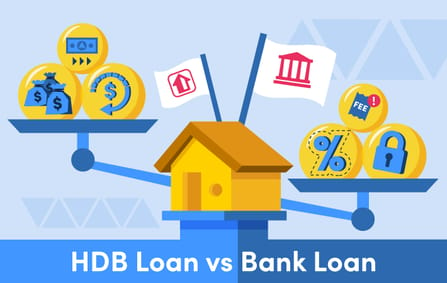
What is an HDB Loan?
An HDB loan is a concessionary loan offered by the Housing & Development Board to help Singapore citizens afford their HDB flats. This means that the concessionary interest rate is pegged at 0.1% higher than the prevailing CPF Ordinary Account (CPF-OA) interest rate, subject to adjustments in January, April, July, and October during CPF interest rate revisions.
Here’s what makes it unique:
- Fixed interest rate of 2.6% (pegged to CPF OA rate + 0.1%)
- You can use CPF-OA savings for entire downpayment (25% of purchase price)
- No early repayment penalty
- Up to 75% Loan-to-Value (LTV) limit
- New flat: Flat purchase price
- Resale flat: The lower of the resale price/value
It’s popular among first-time buyers for its simplicity, predictability, and leniency.
What is a Bank Loan?
Bank loans borrowed from a private financial institution to finance an HDB flat or private property can also be known as a mortgage loan.
Key features include:
- Available in either fixed or floating (“variable”) home loan packages (from 2.20% p.a. as seen on MoneySmart)
- Typically fixed between 1–5 years, before reverting to a floating rate (usually pegged to SORA)
- Requires 25% downpayment, of which 5% must be in cash
- Up to 20% of the downpayment can be financed using CPF-OA savings
- Up to 75% LTV limit
Bank loans may be cheaper at first but come with more complexity and market risk.
Fixed vs Floating Rate Bank Loans: How Mortgage Interest Works
💡 MoneySmart Tip: Singapore Overnight Rate Average (SORA) refers to the average interest rate at which Singapore banks lend to one another in the unsecured overnight interbank SGD market, based on transactions made between 8am to 6.15pm daily. The SORA rate can be calculated as 1-month compounded, 3-month compounded, or 6-month compounded via the Monetary Authority of Singapore’s (MAS) official website.
Here are some wider differences between the two loan types:
| Criteria | Fixed Rate Loan | Floating Rate Loan (SORA & FDR packages) |
|---|---|---|
| Interest rate | Remains the same throughout lock-in period | Fluctuates based on SORA, which reflects market rates |
| Monthly repayments | More consistent and stable | More volatile and prone to fluctuations |
| Loan refinancing | Less flexible during lock-in | More flexible depending on package and penalties |
| Early repayment penalties | Usually higher if prepaid during lock-in | May be lower or waived, depending on package |
| Best for | First-time and/or conservative home buyers | Experienced homeowners |
Unlock Exclusive Mortgage Rates from 1.14%: Complete the Form for Your Special Offer!
Comparison: HDB Loan vs Bank Loan Features
| Loan Feature | HDB Loan | Bank Loan |
|---|---|---|
| Interest rate | Fixed at 2.6% p.a. | From 1.14% p.a. (as seen on MoneySmart) |
| Downpayment | 20% (CPF allowed) | 25% (min. 5% in cash) |
| Loan-to-Value (LTV) limit | Up to 75% of the purchase price for new HDB flats or resale flat (resale price or market valuation, whichever is lower) | Up to 75% of the bank valuation or purchase price of your resale or new HDB flat (whichever is lower) |
| Late payment fee | 8.1% p.a.* | Varies with bank |
| Lock-in period | None | 2–3 years |
| Early repayment penalty | None | Yes, during lock-in period |
| Eligibility | Singapore citizen | Singapore citizens, PRs, and foreigners aged between 21–65 years old |
| Refinancing flexibility | Can switch to bank-issued mortgage loan afterwards | Cannot switch back to HDB loan |
Disclaimer: All figures are accurate as of 29 July 2025. *Late payment charges are reviewed bi-annually.
Beyond interest rates, downpayments, and LTV limits, HDB loans and bank-issued mortgage loans also differ in areas like their lock-in period, early repayment penalties, eligibility, and refinancing flexibility.
HDB loans have no lock-in period, so you won’t incur any early repayment penalties if you pay off your loan early. This also suggests that you’re free to refinance your HDB loan with a bank loan anytime, once it’s fully paid off. In contrast, most bank loans come with a defined lock-in period of 1 to 3 years, during which early repayment will likely trigger penalty fees.
💡 MoneySmart Tip: HDB loan monthly repayments are due on the 1st of each month.
Key Considerations Before Applying For a Home Loan

With an HDB loan, you get a fixed interest rate of 2.6%, which remained unchanged for over two decades. This consistency definitely provides peace of mind, ensuring your monthly loan repayments stay predictable, making budgeting and planning for other long-term financial goals much easier.
Conversely, bank loans offer more flexibility in terms of fixed versus floating rate packages. Plus, if timed right, you can capitalise on special promo periods (like this 2.20% rate on MoneySmart!) and enjoy lower interest rates than HDB’s. That said, we must preface that with potential saving comes risk: once the fixed lock-in period of your bank loan ends, your loan may revert to a floating rate pegged to SORA, which fluctuates with market conditions.
Basically, if you’re a homeowner who appreciates stability and predictability, an HDB loan keeps things simple. But if you’re more financially savvy and comfortable navigating rate changes while optimising costs, a bank loan could offer more upside.

HDB loans allow you to use your CPF-OA savings to cover the entire 20% downpayment, eliminating the need for any cash outlay. This is advantageous for buyers with significant, accumulated CPF funds but lack large cash reserves on hand.
Conversely, bank loans require a higher minimum 25% downpayment, with at least 5% of it to be paid in cash. This cash requirement can pose a challenge, especially for younger buyers or those with tight liquidity.
In short, if you’re cash-light but CPF-rich, an HDB loan makes homeownership more accessible and affordable.

Conversely, if you see your HDB flat as a shorter-term home or a stepping stone to a future upgrade (like condominiums or private property), then a bank loan could be more cost-effective. Locking in a promo fixed rate for the first few years could lower your initial costs, especially if you plan to refinance or sell before the floating rate kicks in. Just remember that refinancing or repaying early during the bank loan’s lock-in period is likely to incur penalties.

However, the reverse is not true: once you’ve taken up a bank loan, you cannot switch back to an HDB loan, even if you meet all the eligibility criteria. This makes the “HDB → Bank loan” route a one-way street. As a result, many first-time home buyers tend to choose an HDB loan to start with, giving them the upfront accessibility while preserving the flexibility and option to refinance with a bank loan later, if bank promo rates become more attractive.

In general, HDB loans are more accessible without needing a stellar credit score. Instead, eligibility depends more on your Singaporean citizenship, annual income ceiling, and whether you already own a property.
In contrast, bank loans involve a stricter credit assessment. Banks will evaluate your credit history, gross monthly income (plus income stability), and other existing debt obligations under the Total Debt Servicing Ratio (TDSR) framework.
Overall, your TDSR cannot exceed 55% of your gross income if you’re applying for a bank loan to finance your HDB flat.
💡 MoneySmart Tip: If you’re applying for a second property loan, the monthly repayments of your existing residential mortgage (HDB or bank loan), can be excluded from TDSR calculations but only if the existing property is owner-occupied and specific conditions are met. This includes providing a signed declaration and supporting documents.

| Yes | But also, |
|---|---|
| ⬆️ Higher LTV = ⬆️ higher borrow limit = ⬇️ lower downpayment | ↗️ Increases monthly loan repayment amount + total interest costs |
| ⬇️ Lower LTV = ⬆️ higher downpayment | ↙️ lower long-term interest costs |
For example, if you’re offered the maximum LTV of 75%, you can borrow up to $750,000 on an HDB flat valued at $1 million. But here’s the catch: your approved loan amount depends on whichever is lower—the property valuation or price.
So if you agree to buy a property at $1.2 million, but the bank’s valuation only sits at $1 million, your maximum approved loan amount remains at $750,000. This means that you’ll need to cover the leftover $450,000 shortfall in cash—$200,000 above the valuation and $250,000 as your downpayment.
Why Guess When You Can Calculate? 🧮
Eligibility Criteria: How to Apply For an HDB Loan?
To qualify for an HDB loan, you must:
- Be a Singapore citizen. PRs and foreigners are not eligible.
- Not own any private property.
- If Singaporean aged 55 and above: Not applying for a 2-room Flexi flat on short lease.
- If single aged 35 and above: Either buying a 2-room Flexi HDB flat on 99-year lease or 5-room or smaller resale flat.
- Fall within the monthly household income ceiling ($14,000 for families, $21,000 for extended families, and $7,000 for singles).
- Apply for an HFE (HDB Flat Eligibility) letter before beginning the HDB-buying process.
Note: The HFE letter is now mandatory for both buying and applying for the HDB loan.
Common Mistakes When Choosing a Home Loan
Deliberating between an HDB or bank loan can be complicated and feel overwhelming, especially if it’s your first time navigating the process. To make things smoother, here are a few common pitfalls to watch out for:
❌ Skipping the HFE letter. Without your HFE letter, you can neither proceed with your HDB flat nor loan application.
❌ Not comparing fixed vs floating bank packages. Each type has its pros and cons, don’t just blindly commit to the first interest rate you see.
❌ Assuming you can revert to an HDB loan from a bank loan. You can only refinance an HDB loan with a bank loan, not the other way around.
❌ Overlooking early repayment penalties and lock-in periods. Bank loans often come with fixed lock-in periods and penalties if you want to pay off or refinance early.
Frequently Asked Questions
Is a home loan required for your HDB?
- No, not everyone needs a home loan for their HDB flat. If you can afford to pay your flat fully with CPF or cash, a home loan isn’t mandatory.
But if you’re in need of extra finances, you can opt between an HDB loan or a bank-issued mortgage loan. How much CPF savings can I use for my property purchase?
- The amount of CPF-OA savings you may use to purchase property depends on the property’s remaining lease, property type, loan type, and whether it’s your first or subsequent property.
Is HDB loan interest rate always lower?
- Not necessarily. Some bank promos offer lower initial rates (as seen on MoneySmart) but are subject to change without prior notice.
Can I use CPF to pay for a bank loan’s entire downpayment?
- No. You can only use CPF-OA savings to pay up to 20% of the 25% HDB downpayment. The remaining 5% must be paid in cash.
Alternatively, you can just pay the entire HDB downpayment in cash. Can I switch loans to refinance my HDB later on?
- You can only refinance an HDB loan to a bank loan, not the other way around.
What’s the maximum loan tenure for HDB and bank loans?
- For HDB loans, the maximum tenure is 25 years, or until the borrower turns 65, whichever is earlier.
For bank loans, it can go up to 30 years, but if the loan exceeds 25 years or past age 65 of the borrower, your LTV limit drops to 55%. Do I need a good credit score to qualify for an HDB loan?
- No, HDB loans are not credit-score dependent. Approval is based on citizenship, income ceiling, and property ownership status.
On the other hand, bank loans are credit-assessed, and your score affects both approval and interest rate offered. Can I take a bank loan if I’m purchasing a new BTO HDB flat?
- Yes, you can take up a bank loan to finance a new flat as long as you meet the bank’s credit assessment. Although it’s worth noting that most first-time home buyers prefer an HDB loan instead due to its lower upfront cash needs.
Can I repay my HDB or bank loan early?
- Yes, you can repay your HDB loan early any time with no penalties.
No, you cannot repay your bank loan early. Early repayment penalties may apply during the loan’s lock-in period. How long does it take for my loan to get approved?
- You’ll need to apply for an HFE letter first before you can even apply for an HDB loan, and get approved.
Meanwhile, a bank loan typically takes 3 to 5 working days, depending on document review and bank response times.