

Mortgage Broker vs Bank: Your Essential Guide for 2026

Should you use a mortgage broker or go directly to the bank? Brokers offer access to multiple lenders and personalised guidance, while banks provide direct access to their own products—but which route saves you time, money, and stress?

With rising property prices, tighter lending guidelines, and more financing options available, this guide breaks down how brokers and banks differ in fees, service, and regulation to help you make an informed choice.
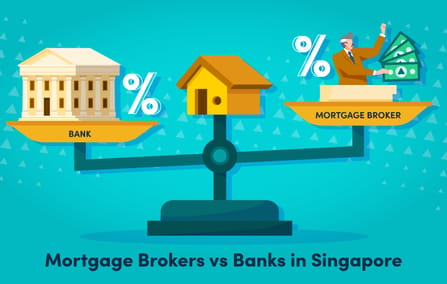
masthead-media

Mortgage Broker vs Bank: Definitions & Key Differences

Understanding the different players in Singapore’s home loan space is key to making smart, confident decisions. Here’s a clear look at the distinctions between mortgage brokers, banks, agents, and specialists.

What is a bank?

Banks are MAS-regulated financial institutions offering a full range of financial services, but they can only offer their own home loan products, not those from other banks. Their mortgage specialists or relationship managers can only advise and service you on their employer's loan packages.

Who are mortgage brokers?

Mortgage brokers are independent intermediaries who help borrowers compare home loan options across multiple banks and lenders. They’re regulated under the MAS Financial Advisers Act or as Exempt Insurance Brokers, meaning they must hold proper accreditation, disclose all fees, and put your interests first. Always verify your broker is MAS-recognised before engaging.


If navigating multiple banks feels overwhelming, our qualified mortgage specialistsare here to guide you. With deep experience in Singapore's home loan landscape, they'll help you compare options, understand what different packages really mean for your situation, and make informed choices that align with your financial plans.

What about agents and specialists?

Bank agents work for one bank and offer only that bank's products. Broker agents work with multiple lenders and can compare across the market. Both must follow MAS rules, but brokers provide broader, more objective access.

Background image

Meet our financial advisors

You don’t need to do this alone. Our advisors are here to help you plan it right.
Secure your home with the right loan at the right rate.
Our Mortgage Specialists don't just push one-size-fits-all mortgage packages. We help you navigate the home loan market to compare rates, optimise your borrowing power, and ensure your mortgage is tailored to your long-term financial goals. Meet our qualified team specialising in home loans.
FA1 Photo
Joey Wong
Senior Mortgage Specialist
‘I’ve spent more than 20 years in the mortgage industry, treating every client like a friend. I'm here to take the stress out of home loans by finding you the smartest, most money-saving mortgage plans available.’
FA3 Photo
Javen Zhu
Mortgage Specialist
‘I help you make smarter moves with one of your biggest financial commitments, your home loan. As your Mortgage Specialist, I cut through the noise of different bank packages and fine print, guiding you toward options that truly make sense for you. Think of me as your go-to person for navigating home loans, without the confusion.’

Speak to our Mortgage Specialists

From Google Reviews: What Our Customers Are Saying

4.4 rating of 2036 reviews
Google

I encountered challenges finding and filling up the right claim form via MoneySmart. Although I have clicked some, I actually not sure. I tried my luck to email MoneySmart support for help. Surprised with their reply within 48 hours by Vinnie Noor. However, I was still not able to access the right form with the link provided. Emailed them again. She replied and even take effort to check through my claim and assured me that my claim went through. I am not sure whether my claim will be successful eventually or not, but I am impressed by MoneySmart’s support team and service. Will definitely use their platform more. Thanks.

jiang yanjiang yan
Google

Appreciate the CS Team, especially Nisa for the kind support!

DreamerDreamer
Google

On a Friday evening, Nisa responded promptly on my concerned about the fulfillment of the gift. Kudos to her switft update I am able to verify that the gift have been transfered to my account. Thank you.

Huang BryanHuang Bryan
Google

Issue is finally resolve. The reasons why I only give 4 stars is the duration which took months to resolve. Anyway its better be late then never. Thanks.

Yeoh GaryYeoh Gary
Google

great service

Ram Narsimha ReddyRam Narsimha Reddy

Brokers vs Banks: Comparison

Feature Mortgage brokers Banks
Loan / Lender range Access to a broad panel of banks and some private lenders Limited to the bank’s own products
Eligibility & flexibility More flexible; supports unique borrower scenarios and varied credit profiles Standardised criteria with stricter eligibility requirements
Approval support Personalised guidance on paperwork and strategies to improve approval chances Limited to in-house application processing and requirements
Borrower costs Standard loan costs apply; broker earns commission from lenders (no direct fee to borrower in most cases) Standard loan costs apply; bank earns through interest and applicable fees
Service flexibility One-stop comparison with flexibility to match your timeline and needs Fixed processes, typically limited to banking hours
Review / Authority MAS-recognised; subject to the Financial Advisers Act MAS-regulated; governed by the Banking Act and consumer protection standards

Mortgage brokers

✅ Pros


  • Market-wide comparison done for you
  • Negotiation with multiple banks
  • No extra fees (paid by lenders)
  • Paperwork handled on your behalf
  • Access to wider loan options

Cons


  • Limited control (can't influence bank decisions)
  • Potentially less personalised service

Banks

✅ Pros


  • Direct control over your application
  • Faster refinancing with same bank
  • May access unadvertised preferential rates
  • Personalised service from bank reps

Cons


  • Only see one bank's products
  • More time to compare yourself
  • Advice may be biased to their products

Cost Comparison: Mortgage Broker vs Bank Fees

One of the biggest concerns when choosing between a mortgage broker and a bank is cost. The good news? Using a broker typically seems more cost-effective. Let us explain.

How broker fees work (and why it's usually free)

Mortgage brokers in Singapore earn commissions from the lenders they work with, not from you. When your loan is successfully approved and disbursed, the bank pays the broker a commission fee. This means full transparency (on all commissions) and no upfront costs or application fees, beyond standard bank charges.


In return, you receive these services for free:


  • Document consolidation, paperwork processing, and verification (credit history, income, CPF statements)
  • Loan comparisons across multiple banks

Why brokers offer better rates

While you won’t pay a brokerage fee going directly to a bank, established brokers have business relationships with multiple banks. Here’s why brokers deliver better value:


  • Access to special preferential rates not advertised publicly
  • Broker-exclusive promotions and rate packages often unavailable through direct applications
  • Banks build margins into interest rates and fees, regardless of your application channel
  • DIY bank applications = more time comparing rates yourself = no guarantee you’ll see the best available offers

💡 MoneySmart Tip:

All in all, using a licensed mortgage broker typically costs you nothing extra and may uncover savings you'd otherwise miss, as opposed to through a bank.

Background image

How to Apply For a Home Loan Via Mortgage Brokers

Step 1

Share your property and financial details

Complete our quick online questionnaire regarding your property type, budget, income, and existing loans.

This takes 1–2 minutes and helps our mortgage specialists understand your needs.
Step 2

Consult our expert mortgage specialists

Once completed, our qualified mortgage specialists will be in touch to:


  • Discuss your priorities,
  • Confirm your home loan eligibility, and
  • Understand your long-term financial goals.


Thereafter, you’ll receive a tailored shortlist of loan packages from multiple banks—including preferential rates not advertised publicly.

Step 3

Review and select your loan

Compare the recommended packages with full transparency on rates, fees, and terms.

Your specialist will explain the fine print, answer questions, and help you weigh trade-offs.

All commission disclosures (if any) are provided upfront.
Step 4

Wait for application and approval

Once you've chosen a loan, your specialist handles the paperwork and bank liaison. You'll need to provide:

  • Proof of income (payslips or tax assessments)
  • CPF contribution statements
  • Identification documents
  • Property purchase documents


1–3 weeks for approval

Step 5

Loan disbursement and repayment

Review your final Letter of Offer, sign acceptance, and coordinate with the appointed law firm to complete conveyancing.

Set up GIRO immediately to avoid missing your first repayment.

Speak to our mortgage specialists

How to Apply For a Home Loan via Banks

Step 1

Research and shortlist your bank

Use MoneySmart's comparison tool to check rates across multiple banks to catch the best deals before committing to one. 


Select your preferred bank based on their advertised rates. Then, visit the bank's website, call their mortgage hotline, or visit a branch to discuss loan packages.

Step 2

Check eligibility & discuss loan options

Meet with the bank's own mortgage specialist to confirm your eligibility based on income, credit history, and property type. They'll explain available packages, rates, lock-in periods, and features—but only from their own product lineup.
Step 3

Review fees and submit application

Request a full breakdown of all costs: legal fees, valuation fees, lock-in penalties, and early repayment charges. Once satisfied, complete the application and submit required documents:


  • Proof of income and employment
  • CPF contribution statements
  • Identification documents
  • Property purchase documents


1–3 weeks for approval

Step 4

Approval and loan acceptance

Receive your Letter of Offer with final terms. Review carefully for accuracy, ask questions about anything unclear, and sign the acceptance form.

Coordinate with the bank and appointed law firm to finalise conveyancing and disbursement. Set up GIRO to avoid missing repayments.

💰 MoneySmart’s Take

We generally recommend working with mortgage brokers for your home loans, especially if you’re a first-time homeowner or unfamiliar with home loan mechanics. Here’s why:

  • You compare rates across the entire market, not just one bank. Brokers give you access to preferential rates from multiple lenders—including offers not advertised publicly—rather than limiting you to a single bank’s product lineup.
  • You pay no extra fees. Brokers earn commissions from lenders, so the comparison service and application support come at no additional cost beyond standard bank charges.
  • The application process is more streamlined and less time-consuming. Your broker handles coordination and paperwork with banks, letting you focus on acquiring the right documents rather than managing multiple applications.

Looking for the best mortgage rates? Our dedicated mortgage brokers are here to get you the best rates

Frequently Asked Questions

Do I have to pay to use a mortgage broker?

Most mortgage brokers like MoneySmart do not charge fees for using their platforms, and they offer free services to consolidate the relevant documents from you, process the required paperwork, reference your credit history, verify your employment, income, and CPF statements for you before helping you to apply for the most suitable home loan.

How do mortgage broker fees and costs really compare to banks?

Here's the key clarification: standard home loan charges are identical whether you use a mortgage broker or apply directly to a bank. You'll pay the same legal fees, valuation fees, admin charges, and any lock-in or early repayment penalties regardless of which route you take.


The difference lies in how your intermediary gets paid:


  • Brokers earn commissions from lenders after your loan is approved. You don't pay them directly.
  • Banks earn through the loan's interest margin and built-in fees. Again, you're not paying a separate "bank service charge."

So engaging a broker doesn't add extra costs to your loan. The benefit comes from potentially accessing better rates or promotions across multiple lenders, which could actually save you money compared to sticking with one bank's offerings.


Most licensed brokers don't charge borrowers directly:


  • Brokers: Paid by the lender after loan disbursement; all commissions must be disclosed upfront as an MAS requirement
  • Banks: No brokerage fee, but product costs (admin fee, legal fees, lock-in penalties) apply 

Generally, there is usually no additional out-of-pocket expense borne by homeowners borrowing a home loan through a mortgage broker. In fact, brokers may even access better rates or promotions you wouldn't find directly via individual banks.

How can I find the best home loan interest rates?

You may tap on online mortgage brokers like MoneySmart’s Home Loans page to find the best home loan rates as it is a good place to start and probably the fastest way to have an overview of the latest rates by most banks.

How do I verify a broker is credible and trustworthy?

It is non-negotiable that all mortgage brokers in Singapore must be MAS-registered. Start by checking they're listed in the MAS Register of Representatives under the Financial Advisers Act or as an Exempt Insurance Broker.


Credible brokers provide written disclosure of all commissions and affiliations upfront, explain lending criteria clearly, and recommend loans suited to your profile. They should offer multiple lender options, not just 1-2 banks.


⛳ Red flags to avoid:

  • Vague fee disclosures or pressure tactics ("guaranteed approval!")
  • Unclear licensing or refusal to provide credentials
  • Limiting your choices without clear rationale

What are the key factors when choosing between a broker vs a bank?

  • Breadth of options: Brokers give you multiple choices, banks only theirs.
  • Fee transparency: All costs and commissions should be disclosed upfront; otherwise, walk away.
  • Support level: Brokers help with paperwork across many lenders; banks do so for only their own products.
  • Time commitment: Brokers do comparison work; banks require you to research independently.
  • Regulatory oversight: Both must comply with MAS standards.

Is repricing different from refinancing?

Yes, they're two distinct approaches.
Repricing Refinancing
Switch packages within your current bank Move your loan to a different bank
Simpler, faster, often free or minimal fees More steps involved; new applications, credit checks, legal/valuation fees
Best when your bank offers better packages and free repricing Best when other banks offer low enough rates to offset switching costs

Can a mortgage broker guarantee loan approval or better interest rates?

No promises. Approval depends on your profile factors like income, credit score, existing debts, property type.


  • What brokers CAN do: Match you with suitable lenders, negotiate better terms, position your application strategically
  • What brokers CAN'T do: Override bank credit policies or guarantee outcomes

Brokers increase your odds but can't guarantee results.