Life is unpredictable. What you leave behind doesn’t have to be.
So whether you’re supporting elderly parents, raising young children, or carrying a mortgage, life insurance ensures your loved ones won’t face financial crises during an already difficult time.


Why Do I Need Life Insurance?
If anyone depends on your income, it’s your responsibility to have life insurance. Singapore's high cost of living makes this critical.
To put things into perspective: An otherwise manageable mortgage on dual incomes can suddenly be overwhelming for a surviving spouse. Life insurance replaces your income, pays off debts, funds your children's education, and maintains your family's living standard—giving your loved ones time to adjust and plan without financial pressure.
Life insurance matches different needs and budgets through term life, whole life, and hybrid options.







Types of Life Insurance Policies in Singapore
Term life insurance
Term life insurance provides coverage for a fixed period, such as 10, 20, or 30 years. If you pass away within this term, your beneficiaries will receive the death benefit. However, if you outlive the policy term, there’s no payout or surrender value.
Term plans are generally more affordable than other types of life insurance, making them a popular choice for those seeking pure protection for specific financial responsibilities—like covering your children’s university fees or replacing your income until your dependents become financially independent.
Key features:
✅ Coverage for a set period only
✅ No cash value; purely protection-focused
✅ Typically has lower premiums
Whole life insurance
Whole life insurance offers lifelong protection, paying a death benefit regardless of when you pass away, as long as premiums are paid. Apart from the death benefit, whole life policies have a savings component that allows you to build cash value over time. Overall, whole life plans tend to have higher premiums than term life policies because of the lifetime coverage and cash accumulation.
Key features:
✅ Lifelong coverage (as long as premiums are maintained)
✅ Accumulates cash value
✅ Higher premiums compared to term plans
Endowment plans
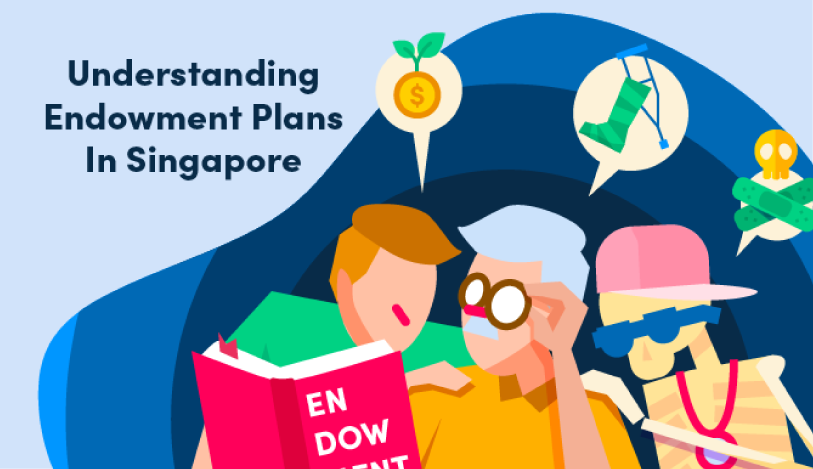
Endowment plans are a blend of life protection and savings. They provide life insurance cover for a set policy tenure. If you pass away during the term, a payout is made; if you survive to the end of the term, you’ll receive a lump sum comprising guaranteed and non-guaranteed bonuses. Many Singaporeans use endowment plans for medium- to long-term savings goals, such as funding a child’s education or saving for future home renovations.
Key features:
✅ Combined protection and savings
✅ Lump sum payout at policy maturity or upon death during the term
✅ Useful for legacy and financial goal-planning
Investment-Linked Policies (ILPs)
Investment-linked policies combine life insurance coverage with investment opportunities. Part of your premium goes toward life insurance, while the rest is invested in sub-funds of your choice. The value of your policy can fluctuate based on investment performance. While ILPs offer flexibility and potential for higher returns, they also carry investment risks and may require active management to match your risk appetite.
Key features:
✅ Dual focus on both protection and investment elements
✅ Policy value depends on fund performance, which may fluctuate
✅ Provides coverage but with higher risk and possible returns

Meet our financial advisorsYou don’t need to do this alone. Our advisors are here to help you plan it right. Our advisors aren’t here to push plans. They’re here to understand your life, answer your questions, and help you protect what matters most. Meet our MDRT-qualified specialist and his team. |
|


Protection for every life stage
There’s always something to protect. No matter where you are in life.
Discover how life insurance fits into your life right now.
|
|





Key Features Across Life Insurance Policies: Comparison
| Feature | Term life insurance | Whole life insurance | Endowment plan | Investment-linked policy (ILP) |
|---|---|---|---|---|
| Premiums | Lower; fixed for policy term | Higher; can be fixed or limited-pay | Moderate; usually fixed over savings period | Varies; may change based on insurance/investment allocation |
| Coverage amount | Flexible; choose sum assured | Flexible; lifelong coverage; can increase with bonuses | Predetermined; typically lower than term/whole life | Depends on sum assured and fund value |
| Policy term | Fixed (e.g. 10, 20, 30 years) or yearly renewable | Lifetime (as long as premiums are paid) | Fixed (matches savings goal, e.g. 10–25 years) | Renewable, often up to a maximum age |
| Cash value | None | Yes; builds savings/bonus component | Yes; payout at maturity (guaranteed + bonuses) | Value fluctuates with investment performance |
| Flexibility | Option to renew/convert, cancel anytime | May allow partial withdrawals | Limited liquidity (early withdrawal penalties may apply) | Switch funds, adjust coverage/investment split |
| Riders / add-ons | Available (e.g. critical illness) | Available | Limited availability | Available; may include waiver / CI riders |
Below is a concise guide on key features to look out for when comparing life insurance policies in Singapore:
Premiums
ILP premiums can be flexible but may fluctuate based on coverage and investment options.
Coverage amount
Policy term
Term and endowment plans provide coverage for a fixed period, while whole life offers lifelong assurance. ILPs typically provide renewable coverage up to a certain age.
Cash value
Only whole life, endowment, and ILPs build up accessible cash value, whereas term plans are pure protection with no cash-out option.
Flexibility
ILPs offer the most fund flexibility and adjustable coverage/investment allocations.
Whole life may allow for premium holidays or partial withdrawals, while endowment plans are relatively rigid, optimised for reaching a savings goal.
Riders/Add-ons
How to apply
Everyone talks about why you need it. Few explain how easy it is to start.
Learn how you can protect your loved ones in your absence in 3 simple steps.
|
|||||||||
|
|
||||||||




How to Choose the Right Life Insurance: Step-by-Step Guide
Calculate your coverage needs
Estimate how much your family needs to maintain their lifestyle without your income. Include outstanding debts (housing loans, car loans), children's education costs, and elderly care expenses.
A common rule: 10 times your annual income, adjusted for your specific obligations.
Get expert guidance on coverage and budget
Not sure how much coverage you need or what you can afford? Speak to a MoneySmart financial advisor who can assess your dependents' needs, match coverage to your timeline and recommend policies that fit your budget, without overextending your finances.
Compare insurer reputation and claims process
Review policy terms and exclusions
\Read the fine print for exclusions (pre-existing conditions, risky activities, specific occupations). Consider riders like critical illness coverage or premium waivers if they address gaps in your protection.
Which Type of Life Insurance is the Best Fit for Me?
#1: Breadwinners and main income earners
| Use case | Best fit | Coverage duration | Plan matching |
|---|---|---|---|
| You're the main income earner carrying most of your household's financial obligations |
Whole life or long-term term life insurance is ideal Provides sustained protection to replace income and cover household expenses Whole life adds cash value build-up for long-term financial security |
Whole life: Lifetime coverage Term life: Match to your working years (e.g. 20–30 years until retirement or children’s independence) |
Aim for coverage at least 10× your annual income to fully replace your earning power and cover dependent obligations |
#2: Young families & new parents
| Use case | Best fit | Coverage duration | Plan matching |
|---|---|---|---|
| You're raising young children while juggling housing loans, childcare, and education expenses |
Term life insurance offers maximum coverage at affordable premiums Pure protection (no savings component) keeps costs low during high-expense years |
15–25 years is typical Match coverage until children complete university or become financially independent |
Target S$500k–S$1M+ sum assured depending on outstanding debts, education costs, and ~5–10 years of income replacement needs |
#3: Expats without employer life cover
| Use case | Best fit | Coverage duration | Plan matching |
|---|---|---|---|
| You're a foreign professional in Singapore without employer group life insurance |
Many employer schemes only provide basic coverage Standalone term or whole life insurance helps fill the protection gap with portable coverage |
Term life: Until expected return to your home country Whole life: If planning to settle permanently in Singapore |
Check eligibility requirements:
|
#4: Self-employed and SME owners
| Use case | Best fit | Coverage duration | Plan matching |
|---|---|---|---|
| You're self-employed or run a business without company-sponsored insurance |
Whole life or term life with flexible payment terms Coverage should protect both personal finances and business continuity needs Consider 5–25 year payment periods for flexibility |
Whole life: Lifelong protection with cash value for business emergencies Term life: Coverage during peak business-building years |
Coverage amount should factor in:
|
#5: "Sandwich Generation" caregivers
| Use case | Best fit | Coverage duration | Plan matching |
|---|---|---|---|
| You're supporting both children and ageing parents with dual financial obligations |
Whole life insurance is highly recommended Provides lifetime protection as caregiving responsibilities may extend into retirement years |
Lifetime coverage ensures protection doesn’t lapse while dependents still rely on you Cash value can supplement retirement or emergency needs |
Choose a higher sum assured reflecting dual obligations:
Consider adding critical illness riders due to increased caregiver health risks |
#6: Singles with no dependents
| Use case | Best fit | Coverage duration | Plan matching |
|---|---|---|---|
| You're single with limited dependents and may plan to start a family in the coming years |
Basic term life insurance may be sufficient at this stage Lower premiums help preserve budget for savings and investments |
10–20 years provides flexibility Option to renew or upgrade when life circumstances change |
Start with modest coverage (S$100k–S$300k) to cover:
|
Explore life insurance plans

|
Up to S$500,000*
|
Accumulating cash value including bonus
|
15, 20, or 25 years
|
|
Death, terminal illness, total permanent disability payout.
|
Including bonuses over time.
|
Flexible premium payment terms.
|
|
A flexible whole life plan with customisable protection and savings options.
|

|
Up to S$5 million
|
Life stage withdrawal
|
Retrenchment benefit
|
|
Death, terminal illness, total permanent disability payout.
|
Access bonuses during key milestones.
|
Premiums waived for up to 12 months.
|
|

|
Up to S$500,000*
|
Flexible cash access
|
Retrenchment benefit
|
|
Death, terminal illness, total permanent disability payout.
|
Access Annual payouts from age 50.
|
Premiums waived for up to 6 months.
|
*The above figures are based on an assured sum of S$100,000 and the maximum available multiplier. Actual premiums and coverage amounts may vary based on individual circumstances, underwriting assessments, and selected policy options. For personalized advice and accurate quotations, please consult directly with a licensed financial advisor or the respective insurance providers.
|

|
~S$300,000**
|
Flexible cash value conversion
|
Critical illness rider
|
|
3x protection against death, terminal illness, and total permanent disability
|
Receive annual payouts over 10 years with extra 5% interest
|
Lump sum or premiums waiver during CI onset
|
|
A flexible whole life plan with customisable protection and savings options.
|
Disclaimer
*The above figures are based on a generic coverage/minimum entry point of S$500,000 per policyholder.
**The above figures are based on an assured sum of S$100,000 and the maximum available multiplier.
Actual premiums and coverage amounts may vary based on individual circumstances, underwriting assessments, and selected policy options. For personalized advice and accurate quotations, please consult directly with a licensed financial advisor or the respective insurance providers.
Not ready to talk yet? Read more about Life Insurance here.



FAQs about Life Insurance in Singapore
What happens if I miss a premium payment?
You typically get a 30-day grace period to pay without losing coverage. Some policies offer backup options:
- Automatic premium loans (uses cash value to cover payments)
- Cash value drawdown (for whole life/investment-linked policies)
Contact your insurer immediately if you're struggling with payments. They may offer temporary solutions.
Can I change or upgrade my plan later?
Yes. Common adjustments include:
- Add riders: Critical illness, premium waivers
- Increase coverage: At life milestones (marriage, children, promotion)
- Convert term to whole life: Some policies allow this without new medical exams (before age 65-70)
Review your coverage when circumstances change. Speak to our MoneySmart financial advisors to assess and ensure that your protection still fits your needs.
Is life insurance necessary if I already have MediSave?
CPF insurance in Singapore includes mandatory national schemes to cover health and long-term care, primarily funded by the MediSave account. Key components include MediShield Life (basic, universal hospitalisation coverage) and CareShield Life (long-term disability support). You can also use MediSave for private Integrated Shield Plans and Dependants’ Protection Scheme (life insurance).
While these schemes provide crucial safety nets, they serve fundamentally different purposes than standalone life insurance:
CPF Schemes (like CPF LIFE) provide retirement income while you’re still alive, not death benefits for your family. Meanwhile, life insurance serves a different purpose:
- CPF LIFE: Monthly payouts during retirement
- Life insurance: Lump sum death benefit to cover debts, education, living expenses
If you have dependents relying on your income, life insurance ensures they're financially protected—something CPF alone cannot provide.
While these schemes provide crucial safety nets, they serve fundamentally different purposes than standalone life insurance:
- CPF LIFE: Monthly retirement income during your golden years
- Dependants' Protection Scheme: Limited coverage tied to CPF housing loans (max S$70,000)
- Life insurance: Comprehensive death benefit to replace lost income, cover all debts, fund children's education, and maintain your family's standard of living
If you have dependents relying on your income, standalone life insurance ensures they're fully protected financially—something CPF schemes alone cannot provide, especially for income replacement needs that far exceed the DPS coverage limits.
Can I have more than one life insurance policy?
Yes. Many Singaporeans layer policies to match different needs:
- Term + whole life: Affordable coverage now, lifelong protection later
- Multiple term plans: Adjust coverage as family grows or debts reduce
- Different insurers: Compare benefits and pricing across plans
Just ensure premiums fit your budget and each policy serves a clear purpose.
How do I make a life insurance claim?
To make a life insurance claim in Singapore, follow these general steps:
- Notify insurer as soon as possible
- Submit documents: Claim form, death certificate, medical reports
- Insurer reviews and may request additional information
- Payout disbursed to nominated beneficiaries
Each insurer has specific requirements; check your policy documents or contact them directly for exact procedures.