Key Takeaways
Couple travel insurance can be cheaper than two separate policies, especially for shared risks like trip cancellation or medical emergencies.
Most insurers in Singapore now cover unmarried or LGBTQ+ couples, provided both are on the same itinerary.
Honeymoon perks (like wedding attire or jewellery cover) are not standard so always check policy details.
Frequent travellers can benefit from annual joint plans, which may offer better value than repeat single-trip purchases.
Planning that romantic getaway or honeymoon? Travel comes with shared joys, but also potential mishaps.
Couple travel insurance offers both financial relief and peace of mind. In Singapore, savvy travellers often look for joint coverage—not just to save, but to streamline claims and suit dual travel styles.
Whether you’re jetting off for a short trip to Korea or trekking honeymoon trails in Europe, here’s everything you need to know.
What’s included in couple travel insurance
Couple policies mostly mirror single-traveller cover. The real difference is how limits and triggers apply when two people share a trip. Watch for whether protections are per person or pooled, and how add-ons attach to one or both travellers.
Coverage type | How it typically works for couples | What to check |
|---|
Medical expenses | Usually per-person limits, but some benefits (e.g., hospital cash) can be shared-style | Are medical caps per person or shared? Any sub-limits by age/condition? |
Trip delay / cancellation | Joint claims can apply if either partner hits a covered trigger, esp. for shared bookings | Is cancellation triggered by one traveller’s event? Proof for shared expenses? |
Baggage loss / delay | Often per person, but per-item caps still bite (watch jewellery & electronics) | Are valuables covered at market value or sub-limits? Receipts required? |
Add-ons (adventure, cruise, CFAR) | Sometimes attach to the whole policy; others can be bought per traveller | Can you add a rider for only one partner? Are high-risk activities excluded? |
Who qualifies for couple plans in Singapore
You don’t need to wave a marriage cert at the checkout page. Insurers usually define “couple” as two adults travelling together on the same journey—but wordings differ, so read the definition.
Example definitions show “couple = you and your partner” travelling together (Chubb), or “up to two adults” (FWD). Always confirm the exact wording and whether “partner” must be legally married.
If you’re booking under separate Passenger Name Records (PNR) but travelling together, most insurers still recognise the joint trip; keep proof of shared itinerary (accommodation, activities).
LGBTQ+ couples are generally treated like any two adult travellers under “couple” language; if in doubt, opt for
two single policies to avoid eligibility headaches.
Best couple travel insurance plans in Singapore (2026)
Not all “couple-friendly” plans solve the same problem. Some optimise convenience (auto payouts, app-based claims). Others maximise flexibility (pick-and-mix riders), or global reach (24/7 assistance with big networks). Here’s a snapshot of popular options and what they’re good at for two people:
Insurer | Joint vs individual premium* | Add-on flexibility | Claim process | Adventure / honeymoon activities |
|---|
Tiq by Etiqa | ~S$60 joint vs ~S$65 two singles | Riders for COVID-19, pre-existing conditions | Automated flight delay payouts, PayNow reimbursements | Covers cruises, some leisure sports (check sub-limits) |
FWD | ~S$65 joint vs ~S$70 two singles | CFAR (“Cancel For Any Reason”), Pre-X rider | Digital-first, app claims, fast e-payments | Honeymoon add-ons limited; leisure sports add-on available |
Singlife | ~S$72 joint vs ~S$78 two singles | Standard add-ons; higher tiers offer “unlimited” overseas medical | PayNow claims, digital servicing | Covers leisure/adventure activities; cruise cover available |
Allianz | ~S$75 joint vs ~S$82 two singles | Wide extras, some business add-ons | 24/7 hotline, paperless claims | Cruise cover; strong support for multi-country honeymoons |
*Estimates based on two Singapore residents (age 30), 7-day ASEAN trip, mid-tier plan. Actual premiums vary with age, destination, trip length, add-ons, and promotions.
Disclaimer: These premiums are illustrative mid-tier estimates, derived from MoneySmart and insurer quote ranges available. Your actual premium may be higher or lower—always run a live quote for exact pricing.
When joint coverage makes sense vs when to go solo
A joint policy shines when your trip is truly joint: one set of bookings, shared decisions, same dates. The claim friction drops because one event can protect both of you. But if your trips diverge, forcing both under one umbrella can backfire.
Choose joint when:
You share flights/lodging; one partner’s covered event (e.g., medical) would realistically cause both to cancel; you value one-and-done claims.
Choose two singles when:
One partner extends the trip; you’re doing different risk profiles (e.g., scuba vs spa); you want independent per-person benefits and riders.
CFAR riders
can soften indecision (e.g., if you might change dates for personal reasons)—but they cost more; buy them only if your plans are genuinely uncertain.
Quick scenario
If your partner falls ill before departure and you both need to cancel, a joint plan can simplify the paperwork into one cancellation claim tied to the same receipts. If only one cancels (and the other still goes), two singles often make more sense.
READ: Best Travel Insurance with CFAR Coverage in Singapore
Honeymoon-specific travel insurance coverage
Honeymoons add sentimental (and sometimes high-value) items to the mix. In SG, a dedicated “wedding dress/ring” cover is not standard—those items usually sit under personal belongings with per-item sub-limits.
If your attire or jewellery is significant, either (a) declare and seek written confirmation of limits, or (b) look for specialty riders, or (c) insure the item separately.
What to consider:
Rings & jewellery: Expect sub-limits and proof of ownership; consider separate valuables insurance
Cruises & romantic excursions: Check cruise clauses and adventure/activity riders (e.g., scuba, winter sports)
Event-linked costs: If a ceremony or paid experience abroad is pivotal, CFAR may protect the “we just can’t go now” scenarios better than standard cancellation triggers
How claims work for joint travel plans
Claims are simpler if you prepare like a project manager. The couple-specific twist is shared documentation.
Trigger — Identify which insured event applies (illness, injury, airline cancellation)
Paper trail — Keep joint receipts (flights/hotel), medical certs, and confirmations
Submit smart — Use portals/apps and enable PayNow where offered for faster payouts
MoneySmart Tip
Declare pre-existing conditions for both upfront. Riders exist for some providers; non-disclosure is a common reason for denial.
Couples with different travel habits: is a joint plan still worth it?
Sometimes opposites attract—but what does that mean for your insurance?
Here are two common scenarios:
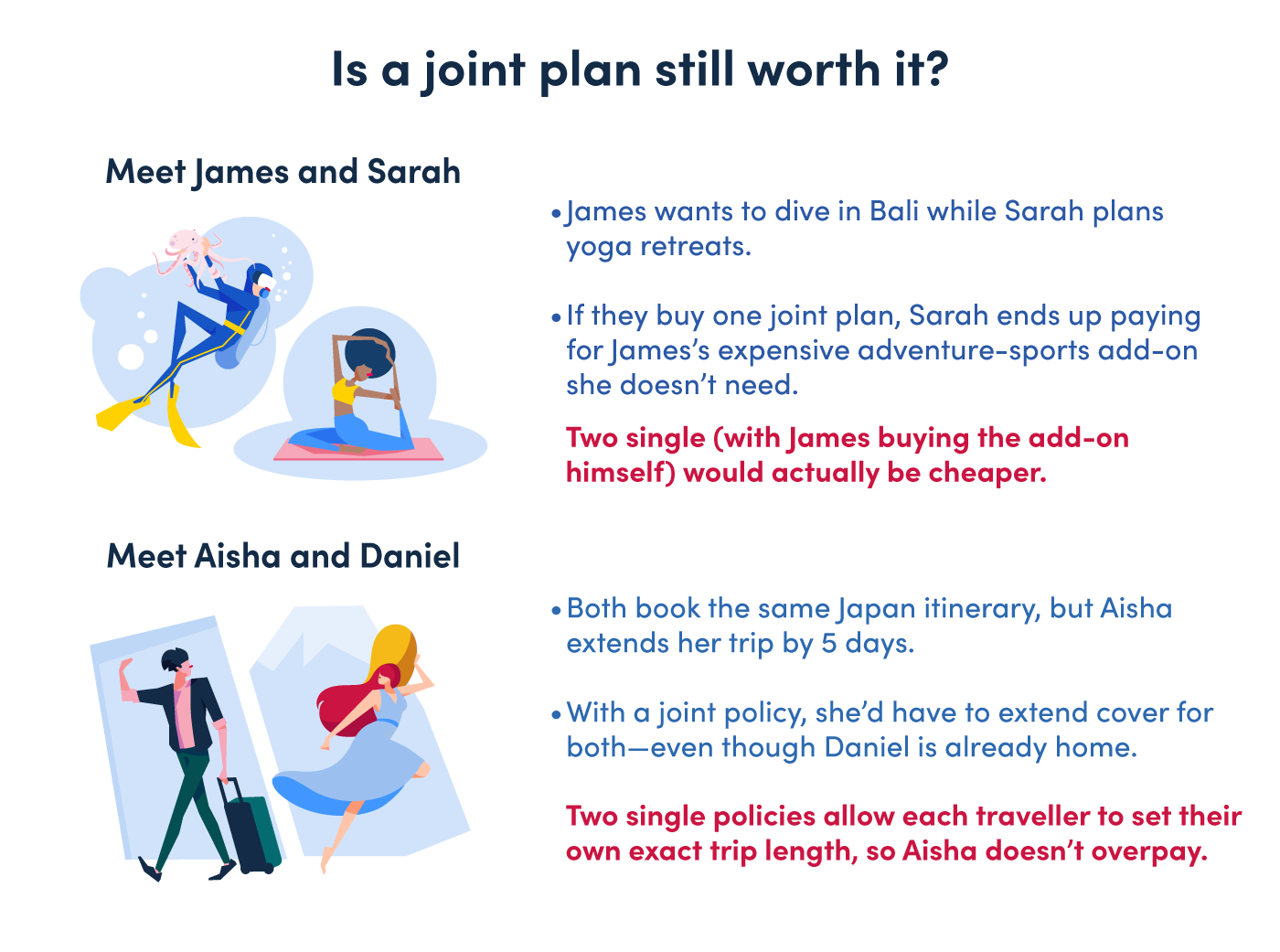
👉 The lesson
Joint policies work best when your trip style and dates are aligned. When they diverge, singles or “hybrid” plans (a shared base + one rider) save you from overpaying.
Annual plans for frequent couple travellers
If you and your partner treat Changi like a second home, an annual multi-trip plan might make more sense than buying cover each time. The big draw isn’t just convenience. It’s cost efficiency.
Single-trip prices:
A 7-day ASEAN trip for two adults typically costs S$60–75 per joint policy.
Annual plan cost ranges per person:
Between S$180 to S$500 depending on coverage tier and insurer.
Break-even logic:
Planning three or more trips a year? Annual plans often provide better value overall.
Insurer | Max days per trip | Est. annual premium (couple*) | Notable perks or highlights |
|---|
FWD (Annual Premium) | Up to 90 days | ~S$400–500 | Digital-first claims, fast payouts, CFAR & Pre-X riders available |
MSIG (TravelEasy) | Up to 90 days | ~S$400–550 | Adventure sports included, modular add-ons |
Singlife (Prestige) | Up to 90 days | ~S$600–700 | Unlimited overseas medical, PayNow claims, high cancel limits |
Allianz (Silver/Gold) | Up to 90 days | ~S$500–650 | Broad global assistance network, fast claim turnaround |
*T&Cs apply
Note: Estimate based on S$180–500 per person, doubling for couples; exact quotes may vary based on age, destination scope, and plan tier.
Final thoughts
Couple travel insurance isn’t automatically better or worse than buying two single policies.
It really depends on how you and your partner travel. If your itineraries match closely and you’re booking everything together, a joint plan usually keeps things cheaper and simpler at claim time. But if one of you has very different trip lengths or activities, separate policies (with tailored add-ons) can actually give you better value.
Whichever way you go, the key is preparation:
Keep receipts in a shared folder
Declare pre-existing conditions honestly
Take advantage of PayNow or automated payout features when your insurer offers them
That way, you’re not just insured. You’re set up for smoother claims and less stress when plans change.
💡 MoneySmart Tip
Use trusted online comparison tools like MoneySmart's travel insurance comparison to explore coverage limits, premiums, and policy features across leading insurers in Singapore—helping you find the right insurance plan for your trip, quickly.


 Why Trust MoneySmart?
