
 Why Trust MoneySmart?
Owning a car in Singapore is shaped by high upfront costs, strict regulations, and uniquely local fees—making it one of the most expensive places in the world to buy and maintain a vehicle. If you’re considering joining the ranks of car owners in 2026, here are the headline factors you need to know, along with where to find detailed breakdowns in this guide.
Key takeaways
Owning a car in Singapore remains extremely expensive in 2026, with COE, ARF, taxes and dealer pricing pushing even basic models well above six figures.
The sticker price is only part of the cost — buyers also need to budget for insurance, road tax, parking, fuel, servicing and depreciation.
Used cars can lower upfront costs, but buyers should weigh this against higher maintenance risk, financing restrictions and shorter remaining COE life.
Car loans are the default financing option, but personal loans may help in specific cases, such as covering a shortfall or supplementing upfront costs.
The smartest way to buy is to compare total ownership cost, not just purchase price, and to check the latest rules, fees and incentives before committing.
Is Owning a Car in Singapore Worth It?
Now this is a bit of a loaded question with no universal answer. Car ownership in Singapore isn’t just about a mode of transport; it’s a major financial and lifestyle decision, predicated on how much you value convenience, flexibility, and independence.
We’ll break down whether the long-term utility justifies the hefty costs, from rising COE premiums to peripheral expenses like personal and/or car loans, car insurance, and servicing.
Why Is Car Ownership So Expensive Here?
Certificate of Entitlement (COE): The largest single cost. Recent COE bidding rounds in 2025–26 have seen record-high prices, often pushing the total cost of even a modest car past six figures.
Additional Registration Fee (ARF) & Goods and Services Tax (GST): ARF is a tiered tax pegged to your vehicle’s market value, stacking a hefty sum on top of the price tag. With GST at 9% as of 2024, expect this to remain a significant contributor to your overall bill.
New Car Price Bands (2025–26): As a result of the above, brand-new cars (even the most basic models) typically start above $120,000, excluding optional add-ons and insurance.
Loan Eligibility: Most banks require a minimum monthly income, commonly $2,000 or higher, to qualify for car financing. The maximum loan quantum depends on the car’s OMV (Open Market Value), and terms are strictly regulated.
Road Tax & Model Categories: Car model, engine capacity, and emission profile all influence annual road tax. High-powered or luxury models can more than double this recurring cost.
Depreciation Charges: The fastest loss in value occurs in the first few years, making depreciation a silent but major cost driver.
How Much Does It Really Cost? New vs Used Car Ownership Breakdown Table
Choosing between a brand new car or a used car makes a major difference to your wallet—even before you start driving.
Here’s a side-by-side cost breakdown for these common buyer profiles.
Buyer Profile | Sample Model (2025) | Initial Cost (Car + COE + Fees) | First-Year Road Tax | Typical Insurance | Estimated Loan Eligibility (Monthly Income) |
First-time New Car Owner | Toyota Corolla Altis (New) | Around $158,000 | ~$742 | ~$1,200–$1,500 | $2,000+ (Singaporean/PR) |
Used Car Buyer | Honda Fit (5-year-old) | Around $68,000 | ~$578 | ~$1,000–$1,300 | $2,000+ (can be stricter for older cars) |
Illustrative examples based on March 2026 market conditions; actual prices vary by dealer, trim, financing and insurance profile.
Breakdown of Main Car Ownership Costs in Singapore
A car’s final price in Singapore is not just about COE. What buyers usually see on a quotation or invoice reflects the car’s OMV, taxes, registration charges and the dealer’s selling price.
Using a Toyota Corolla Altis 1.6 Standard as an illustrative example, the table below shows how the main cost components can add up under current 2026 conditions.
This example reflects updated fee treatment, including the S$350 registration fee and a S$7,500 VES surcharge for this model under the revised framework.
Car ownership component | Estimated cost |
OMV | S$18,997 |
GST + excise duty | S$5,851 |
ARF | S$18,997 |
Registration fee | S$350 |
Avg. COE in 2026 | S$106,510 |
Road tax (12 months) | S$742 |
VES surcharge (C1) | S$7,500 |
Estimated total basic cost (without dealer fees) | S$158,947 |
Estimated total basic cost (with dealer fees) | S$188,888 |
This example shows why car ownership in Singapore is so expensive even before ongoing costs are added in. Beyond the quoted selling price, buyers should still budget for insurance, fuel or charging, parking, servicing and depreciation when working out the true cost of ownership.
What are the hidden or long-term recurring costs?
1. Maintenance and servicing
Routine maintenance for new cars is generally lighter in Year 1, but costs can ramp up quickly thereafter
Used cars—especially beyond five years—may require more frequent repairs or component replacements, which could add hundreds (or even thousands) per year
2. Parking (Season & hourly)
Monthly HDB season parking fees typically start at $80 but can be higher in central or non-resident locations
Commercial or CBD parking rates escalate sharply, especially during office hours
3. Electronic Road Pricing (ERP) and toll charges
Regular city commuters should budget for ERP—costs vary by route and time
Often adds up to about $50–$200 monthly for peak-hour drivers
Read our blog for the full list of timings and ERP rates.
4. Loan interest
Car loans in Singapore are highly regulated, with maximum tenure and interest rates usually starting around 2.78% p.a.
Over a 7-year loan, you could pay $10,000–$15,000+ in interest alone, depending on loan quantum and car age
5. Depreciation
Depreciation is often a car owner’s largest “invisible” expense. New cars typically lose their value fastest in the first 3–5 years—expect annual depreciation of $10,000–$15,000 for a standard sedan.
Used cars (5 years or older) tend to depreciate more slowly, but the drop still adds up over the ownership period.
Calculating Your True Car Ownership Cost
Understanding the real cost of car ownership in Singapore goes far beyond the showroom price. Here’s a sequential, beginner-friendly walkthrough so you can calculate your true budget—whether you’re considering a brand new or used vehicle.
1. Researching actual car prices
Start by checking the current market prices of your desired models. For new cars, leading aggregators such as sgCarMart and reputable authorised dealers reflect prevailing COE-included prices.
Used car buyers should compare listings on major platforms like sgCarMart, Motorist.sg, and authorized dealer sites to get a sense of price ranges by age, mileage, and condition. Always include the COE component, as this forms the bulk of the upfront cost.
2. Identifying mandatory fees
Add up all the mandatory, one-off fees:
Certificate of Entitlement (COE): The latest COE bid price for your car category
Additional Registration Fee (ARF): A tiered tax based on your vehicle’s OMV (Open Market Value)
Goods and Services Tax (GST): Applied at 9% on the total sale price
Registration Fee: Set at $350 for most cars
Excise Duty: Typically 20% of OMV
Roadworthiness/Fitness Inspection (mainly for used cars): Up to $80+ for transfer inspection. Factor these into your calculation, not just the price tag you see online
3. Calculating bank loan eligibility and comparing new vs used car financing
Most major banks in Singapore (such as DBS and UOB) offer car loans, with maximum loan quantum determined by the car’s OMV:
OMV ≤ $20,000: Up to 70% loan
OMV > $20,000: Up to 60% loan
Banks generally require a minimum gross monthly income of $2,000 (stricter for foreigners and sometimes for older used cars). The maximum loan tenure is 7 years, but for used cars, this is capped such that the car’s age doesn’t exceed 10 years at the end of the loan.
New car loan rates in 2026 typically start around 2.78% p.a., while used car rates may be slightly higher.
Be sure to check your eligibility and use a loan calculator to model repayments.
4. Factoring in road tax by engine capacity and year
Annual road tax in Singapore is determined by your car’s engine capacity, emission scheme, and age.
For a typical 1.6L sedan, expect to pay about $740 annually, while a smaller 1.0L model may be closer to $600. CO2-based surcharges or rebates from the Vehicular Emissions Scheme (VES) can also affect your road tax bill. Confirm the latest brackets on the LTA website.
5. Estimating insurance and monthly running costs
Car insurance premiums vary according to age, driving experience, and car type. For a new driver, insurance for base models averages $1,200–$1,500 annually. Monthly running costs also include:
Fuel: ~$150–$250, depending on usage
HDB Season Parking: From $80/month
ERP/road tolls: $50–$200+ for regular commuters
Servicing/Maintenance: After the initial warranty period, set aside $500–$1,000 annually (higher for used/older cars)
6. Working out realistic depreciation
Depreciation is the “real” annual cost of car ownership and is most easily estimated as:
(Total Cost – Prevailing PARF/COE Rebate) ÷ Years of Use
For example, if you buy a $165,000 new car and plan to drive it for 10 years, assuming a $20,000 PARF/COE rebate at the end, your annual depreciation is about $14,500.
Depreciation for used cars is usually lower per year but remember to use the remaining COE and rebate in your calculations.
7. Spotting hidden fees and extra costs
Don’t overlook:
Admin/Dealer Processing Fees: These can range from $300 to over $1,500
Transfer Fees (for used cars): LTA charges $25 per transfer
Roadworthiness Inspection Fees: Needed for ownership transfers of used vehicles
Early Loan Settlement Penalties: If you refinance or redeem early, charges may apply
By systematically running through each of these steps for your preferred models, you’ll get a far more accurate picture of your total financial commitment.
Consider using a car ownership calculator and consulting auto finance experts for fine-tuned estimates. For more details on loan calculations and eligibility, see expertly curated guides located in our personal loans knowledge hub.
Car loans vs personal loans
Regardless of whether you opt for a car loan or personal loan, the Monetary Authority of Singapore (MAS) is quite strict on regulating how much you can borrow to fund your new car.
Criteria | Car loan | Personal loan |
Interest rates
| ||
Loan tenure | Up to 7 years | Typically 1 – 5 years, some up to 7 years |
Loan amount cap | For vehicles < $20,000: Up to 70% of OMV For vehicles > $20,000: Up to 60% of OMV
| Personal loan amounts are usually capped up to 4X monthly income. |
Downpayment required | 30% – 40% of OMV | N/A |
Early repayment penalty | 1% – 2% of outstanding balance, or flat fee | ~1% of outstanding balance, or flat fee (usually between $150 to $250) Some loans such as GXS FlexiLoan offers 0 early repayment fees. |
Flexibility | Lower (secured loan) | Higher (unsecured loan) |
Loan approval | Almost instantaneous within the same day, or at least 1 – 2 working days Fast approval success rates for pre-approved customers
| Almost instantaneous within the same day, or at least 1 – 2 working days |
💡 MoneySmart Tip
Use trusted online comparison tools like MoneySmart's personal loan comparison to review personalised rates, eligibility, and requirements across major banks in Singapore—helping you make a more informed choice quickly.
2026 Policy Updates & Regulatory Changes: What Car Owners Need to Know
Car ownership in Singapore is subject to frequent policy shifts and tax tweaks, some of which can have a major impact on your wallet.
If you’re planning to buy, sell, or finance a car in 2026, here are the most significant regulatory changes and fee updates to keep on your radar.
1. New COE band rules
What’s changing | Who’s affected | Cost impact | Actionable tip |
The Certificate of Entitlement (COE) banding has been restructured to introduce narrower categories Now, they make sharper distinction between regular, premium, and electric models based on their power output and emissions
| Buyers of new cars—especially mid-range and above, as well as most electric vehicles (EVs) Sellers may also need to adjust inventory accordingly
| COE premiums for mid-sized and higher-powered vehicles could diverge further This could potentially lead to even higher bids in some new bands | If you’re considering a mid-range or entry-level EV, check your eligibility first Aim to secure your COE bid before the new banding enforces stricter competition within each segment |
2. Changes to road tax and ARF
What’s changing | Who’s affected | Cost impact | Actionable tip |
Annual road tax bands are set for revision
There will be new emission-linked surcharges on models that do not meet the latest green standards
The ARF thresholds are also being updated, with higher rates for cars with higher OMVs | Owners of older, higher-emission vehicles Buyers of luxury models, and those considering cars with OMV above $80,000 | Higher recurring road tax for non-compliant vehicles Increased upfront ARF for high-value cars | Lock in your car purchase before the 2026 ARF/road tax adjustments take effect This will allow you to benefit from current, lower rates—especially if you’re buying a larger or less green car |
3. GST remains at 9%, but watch for fee absorption changes
What’s changing | Who’s affected | Cost impact | Actionable tip |
Some dealers have announced they will stop absorbing GST on administrative fees and insurance add-ons This went in effect from mid-2025 | All car buyers, both new and used Applies especially to those using in-house dealer financing or adding optional packages | Higher out-of-pocket expenses This is due to full GST being passed on for admin fees, extras, and insurance components. | Clarify with your dealer exactly which charges are GST-inclusive before signing Factor these extra costs into your total budget, as they might not be clearly listed in headline prices |
4. Expiry dates for current incentives and green rebates
What’s changing | Who’s affected | Cost impact | Actionable tip |
Several government incentives for electric and hybrid vehicles—such as the EV Early Adoption Incentive (EEAI) and VES rebates The EEAI scheme has been extended to Jan 2027
The VES period will expire in Dec 2027
| Buyers of electric, plug-in hybrid, and qualifying “green” vehicles
| Loss of rebates of $10,000–$25,000 This could push total ownership costs higher for new green cars post-incentive period | Time your purchase before the announced expiry date This will allow you to maximise savings if you’re planning to go electric/hybrid |
5. Loan finance and application process: New MAS guidelines
What’s changing | Who’s affected | Cost impact | Actionable tip |
The Monetary Authority of Singapore (MAS) is rolling out stricter verification procedures for car loan applicants This includes additional checks on total debt servicing ratios and proof of income | First-time buyers, those with variable or non-fixed income Applicants with multiple ongoing loans
| Longer approval timelines and potentially reduced maximum loan amounts
Some borrowers may need to make a higher downpayment if total debt obligations are high | Prepare up-to-date income documents
Check your total debt servicing ratio before applying
This is especially if you plan to purchase early in 2026 |
6. Changes to depreciation, scrap value, and statistics calculation
What’s changing | Who’s affected | Cost impact | Actionable tip |
Depreciation and scrap value computations will now factor in updated market value indexation There will be more frequent quarterly revisions rather than annual adjustments | Buyers planning long-term car ownership or early COE renewal Sellers calculating resale and scrap value | Annual depreciation rates may become less predictable This will affect cost projections for new and used cars | Recalculate your car’s depreciation using the latest post-February 2026 formula Check the newest quarterly revision before buying, selling, or renewing COE |
Ways to Save on Car Ownership in Singapore
Buying a car in Singapore is expensive, but the right choices can lower your total cost. Beyond the sticker price, you will also need to factor in financing, road tax, depreciation, insurance and running costs.
Here are some practical ways to keep car ownership costs down in 2026.
1. Choose a car that is cheaper to own, not just cheaper to buy
A lower purchase price does not always mean lower ownership costs. Before you commit, compare the car’s total cost over time.
Look at:
OMV and ARF, which affect upfront costs
Road tax, which varies by vehicle type and powertrain
Fuel or charging costs
Insurance premiums
Depreciation and likely resale value
If you are buying used, a car that is around 3 to 5 years old may offer a better balance between price and remaining value than a brand-new model.
Electric-car buyers should also check the latest incentive rules before purchase. The EEAI has been extended to 31 December 2026 with a revised cap of S$7,500, while the VES has been extended from 1 January 2026 to 31 December 2027 with revised bands, rebates and surcharges.
2. Time your purchase carefully
When you buy can affect how much you pay.
Keep an eye on:
COE prices, which can change significantly from one bidding exercise to the next
Policy changes, especially those affecting EV incentives and emissions-based rebates
Dealer promotions, which may lower your upfront cost
COE open bidding is held twice a month, so it is worth checking the latest results before making a decision.
Also, do not assume older rebate rules still apply. EV-related incentives and surcharge bands have already been revised for the current 2026 to 2027 period.
3. Compare car loans, not just monthly instalments
A low monthly repayment can look attractive, but a longer loan usually means paying more interest overall.
Before taking a loan, compare:
Interest rates
Loan tenure
Total repayment amount
Promotional terms
Maximum financing amount
If you can afford the higher monthly payment, a shorter loan tenure may save you more in total interest.
4. Pay attention to road tax and depreciation
These are two of the biggest long-term costs of owning a car in Singapore.
A few things to note:
Smaller conventional cars may still cost less to tax
EV road tax works differently, so do not assume the same rules apply
New cars usually depreciate the fastest in the early years
Older listings may use outdated depreciation assumptions
If you are comparing cars, do not look at depreciation alone. Factor in maintenance, insurance, road tax and resale value as well.
5. Check whether promotions actually lower your real cost
Promotions can help, but not all discounts are as good as they look.
Before signing, check:
whether the discount applies to the car price or just bundled extras
whether there are admin or transfer fees
whether the deal requires you to take a specific financing package
whether dealer, bank and government incentives can be combined
The key is to compare the final payable amount, not just the advertised price.
6. Use this checklist before you commit
Before buying a car, make sure you have checked:
whether new or used makes more financial sense for you
the car’s OMV, ARF, road tax and insurance costs
its depreciation and likely resale value
your loan eligibility and total repayment cost
all admin, transfer and inspection fees
any current EV incentives or dealer promotions
A little extra checking upfront can save you a lot more over the life of the car.
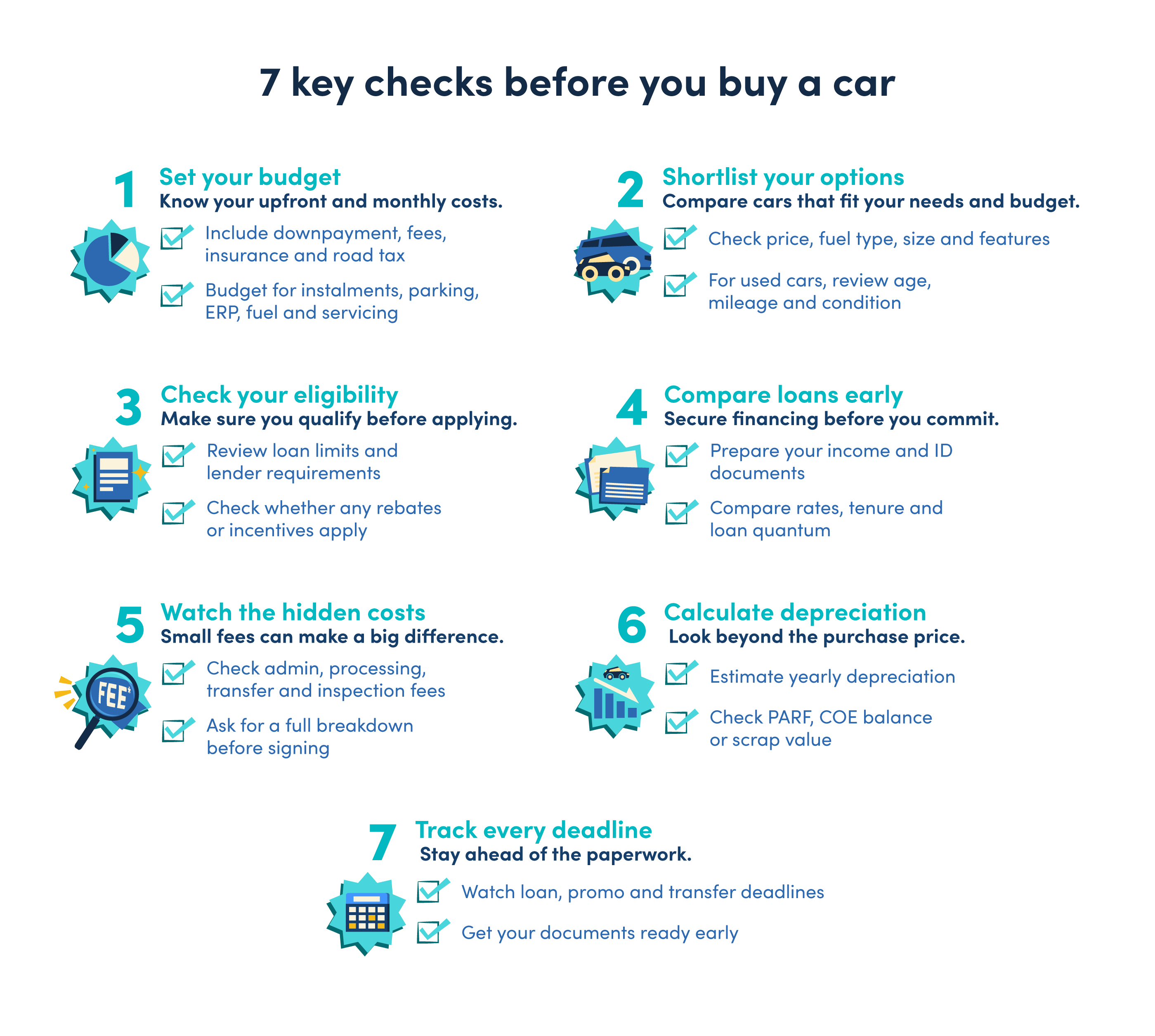
Car Ownership Planning Checklist
Whether you’re eyeing a brand new car or a carefully chosen used vehicle, a step-by-step planning checklist can help you avoid costly mistakes and missed deadlines.
Glossary: Car Ownership & Finance Key Terms Explained
Certificate of Entitlement (COE) | A government-issued license that lets you own and use a vehicle in Singapore for 10 years. |
Additional Registration Fee (ARF) | A tiered tax charged on your car’s Open Market Value (OMV) upon first registration. |
Open Market Value (OMV) | The “true” base value of your vehicle, determined by Singapore Customs, before all local fees, taxes, and COE. OMV dictates your loan quantum, ARF tier, and eventual scrap rebate. |
Road Tax | A recurring annual fee required for all vehicles. Your car’s engine capacity, emission rating, and age determine the bill. |
Goods and Services Tax (GST) | A consumption tax applied to the car’s selling price, including add-ons, accessories, and many admin/processing fees. |
Excise Duty | A one-time tax levied at 20% of your car’s OMV, paid upon importation and before ARF/GST are tallied. |
Registration Fee | A flat $350 fee payable to register a new car. |
Vehicle Emissions Scheme (VES) Surcharge/Rebate | An environmental incentive or penalty, VES applies based on your car’s emissions profile. |
Depreciation | The year-by-year drop in your car’s value, often the biggest “hidden” cost of ownership. |
PARF/COE Rebate (Scrap Value) | The Preferential Additional Registration Fee (PARF) and unexpired portion of COE you’ll get back when scrapping or deregistering your car before 10 years. |
Loan Quantum | The maximum loan amount you can borrow to finance your car. |
Loan Tenure | The repayment period for your car loan. |
Interest Rate (Car Loan) | The percentage charged annually on your loan balance. |
HDB Season Parking | A fixed monthly parking fee for residents to park at HDB car parks. |
Electronic Road Pricing (ERP) | A congestion charge imposed during peak hours at selected roads and expressways. |
Administrative/Dealer Fees | One-off processing or paperwork charges ranging from $300 to $1,500+, often subject to GST. |
Transfer Fee | A $25 fee payable to the LTA when ownership of a used car is officially transferred |

