Understanding COE Expiry and Renewal Process
After the 10-year period, every vehicle owner in Singapore must decide whether to renew their COE or deregister and dispose of their vehicle. That’s why understanding how the COE renewal process works and what happens when a COE expires is pertinent prior to this decision.
It is illegal to drive with an expired COE. If caught with one, you may face fines, and your vehicle will be deregistered, scrapped, or exported. Alternatively, if you renew your COE after it’s expired, a late renewal fee and Prevailing Quota Premium (PQP) for the month will be imposed on you.
PQP refers to the amount required to renew or extend the COE of an existing vehicle in use.
Factors Affecting COE Renewal
#1: Statutory lifespan
When referring to a car’s statutory lifespan, it typically refers to the “official end to its lifespan” in which its COE can no longer be renewed. This varies across vehicle types.
Vehicle | Statutory lifespan |
|---|
Car | None (except for tuition cars registered under companies, where a 10-year statutory lifespan will be applicable) |
Motorcycle | If registered before 1 Jul 2003: Expires on 30 Jun 2028 If first registered from 1 Jul 2003 or under Vintage (Restricted)/Revised Vintage/Classic Vehicle Scheme: None |
Omnibus | 17 years |
Excursion bus, private bus, private hire bus, school bus | 20 years |
Commercial & goods vehicle | 20 years |
Taxi | Non-electric taxis: 8 years Electric taxi registered before Sep 2022 + No opt-in for a 10-year statutory lifespan: 8 years Electric taxi registered from 15 Sep 2022; or before 15 Sep 2022 + opt for 10-year statutory lifespan: 10 years |
#2: PQP rates
COE renewal cost equals the Prevailing Quota Premium (PQP) for your vehicle category. PQP is calculated as the moving average of the last 3 months' COE bidding results. Months without bidding exercises are excluded; for example, if March 2025 had no bidding, PQP uses December 2024, January 2025, and February 2025 instead.
Are PQP and COE price trends the same?
They’re similar, but not exactly the same. Since PQP is the average of COE prices over the past 3 months at a time, it is a smoother, lagging indicator of COE price movements. Hence, they’re less reactive to short-term market conditions and are specifically used to determine the cost of COE renewal.
#3: Market demand and COE price trends
COE prices fluctuate based on demand, economic conditions, and government policies. Rising demand (e.g., families buying sedans) pushes Category A/B premiums higher, while economic downturns or high fuel costs reduce bidding activity and lower premiums.
Why does this matter? Because a higher PQP directly increases your renewal cost. Track COE bidding trends and market forecasts to time your renewal strategically. Renewing during a price dip could save thousands.
#4: Resale value and depreciation
Vehicles naturally depreciate over time, accelerating as a car ages beyond its 10-year mark. Vehicles with renewed COEs typically have lower resale value because buyers prefer cars with longer remaining COE or no prior renewals. Older cars also tend to require more frequent maintenance, raising upkeep costs and reducing overall buyer appeal.
It’s wise to estimate your car’s depreciation before renewing your COE, especially if you plan to sell it soon.
How to Renew a COE in Singapore?
Depending on your vehicle’s category and its statutory lifespan, you can choose to renew your COE for either 5 years (non-renewable upon expiry) or 10 years (renewable again).
5-year vs 10-year COE renewal: Which is better?
Renewal term | Cost | Renewal limits | Best for |
|---|
5 years | 50% of PQP | Categories A/B/D: Once only Category C: Multiple times (5-year intervals only) | Short-term vehicle ownership; uncertain long-term needs; lower upfront cost |
10 years | 100% of PQP | Categories A/B/D: Unlimited renewals Category C: Not allowed (statutory lifespan restriction) | Long-term ownership; vehicles without statutory lifespan; maximises time between renewals |
Overall, 5-year renewals cost less upfront but can only be done once for most vehicles (except Category C). Also, category C vehicles reaching their statutory lifespan must be deregistered regardless of remaining COE validity.
MoneySmart Tip
Deregistering before COE expiry entitles you to COE and PARF rebates where the earlier you deregister, the higher the rebate (redeemable within 12 months).
Documents and eligibility criteria for renewing COE
To renew COE, you’ll need the COE certificate, proof of vehicle ownership, and car insurance details. Apart from these, no other separate vehicle inspection is needed for the renewal per se, as long as your vehicle is in decent condition.
Good news! Unlike when initially obtaining the COE, you don’t need to bid for it again during renewals.
3 Methods to Submit COE Renewal
1. Online
Platform: OneMotoring website (available 6am–12am daily)
Requirements:
Internet banking account (DBS, OCBC, POSB, Standard Chartered, UOB)
Sufficient funds + payment limit covering PQP amount
SGQR PayNow option: Log into mobile banking app → Scan/upload QR code → Authorise payment
2. By mail
Payment checklist:
Cheque/cashier's order payable to "LAND TRANSPORT AUTHORITY"
Cross with "A/C Payee Only"
Write vehicle number + contact on reverse side
⚠️ Important:
Mail at least 2 weeks before expiry (renewal date = LTA receipt date, not postmark)
Expired COE renewals: Cashier's orders only (cheques not accepted)
3. In-person
Best for: Complex queries, statutory lifespan guidance, or need assistance
Bring these documents:
Completed COE renewal application form
Proof of identity (NRIC/FIN/company ID)
PQP payment (cashier's order, NETS, or credit card)*
Processing: Same-day approval with immediate confirmation. Keep receipt for road tax/insurance updates.
*Check with LTA for full array of accepted payment methods
Late COE renewals
Late renewals within the 1-month grace period incur additional fees on top of the required PQP:
Vehicle type | Late renewal fee |
|---|
Motorcycle | $50 |
Private motor car (≤ 1,000cc) | $50 |
Private motor car (1,001cc to 1,600cc) | $100 |
Private motor car (1,601cc to 2,000cc) | $150 |
Private motor car (2,001cc to 3,000cc) | $200 |
Private motor car (> 3,000cc) | $250 |
Business service passenger vehicle (Company car) | $250 |
Goods and public service vehicle | $250 |
Others | $250 |
Generally, vehicles with bigger and more powerful engines, alongside company vehicles, are penalised more.
COE Renewal Prices in Singapore
Since COE renewal prices are determined by the PQP from recent bidding rounds, here’s a look at the past year’s PQP trends to help you set your expectations:
Estimated PQP by COE category
As a reference point, below is how estimated PQPs per COE category* have trended year-on-year, comparing January figures across 2025–2026:
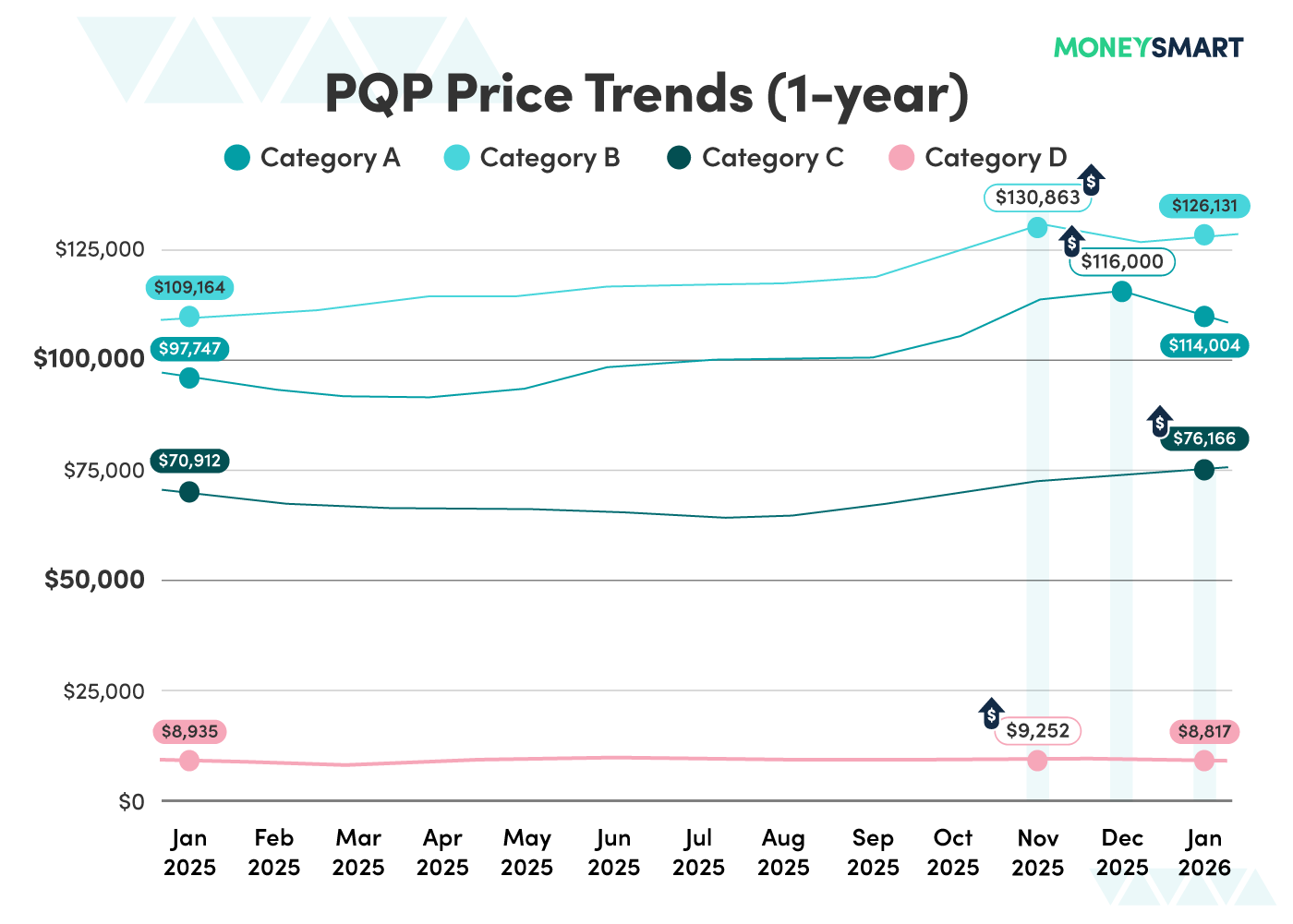
Meanwhile, here's how the latest PQP compares with where it stood at the start of 2026:
Vehicle category | Jan 2026 PQP | Aug 2026 PQP |
|---|
Cat A | $114,004 | $125,646 ⬆️ |
Cat B | $126,131 | $127,835 ⬆️ |
Cat C | $76,166 | $92,599 ⬆️ |
Cat D | $8,817 | $9,923 ⬆️ |
*Disclaimer: Adapted from LTA; accurate as of 27 July 2026. Estimated PQP per COE category is subject to change without prior notice.
PQP trends directly reflect what each category covers, running from most expensive (Category E) to least expensive (Category D):
Category D (Motorcycles only): Narrowest scope, lowest PQP
Categories A & B (Everyday cars): Broadest demand and widest vehicle range, hence highest premiums
Overall, PQPs across all car categories have risen significantly over the past few months.
MoneySmart Tip
Category E has no PQP of its own—it's by COE bidding-only basis. Hence, if your vehicle was originally registered under Cat E, renew using the PQP of its corresponding vehicle category instead.
Renewing COE vs Getting a New Car: What’s Worth it?
Honestly, there’s no right or wrong answer; the correct choice depends on your personal circumstances, like your budget, vehicle’s condition, transportation needs or preferences, and other factors.
Here’s a comparison of the advantages and disadvantages of renewing your COE vs. purchasing a new car altogether.
Factor | Renewing COE | Buying new car |
|---|
Upfront costs | ✅ Lower: PQP typically cheaper than new COE premiums + no vehicle purchase price | ❌ Higher: 30-40% down payment required + new COE premium + vehicle purchase price |
Financing options | ✅ 100% financing available via COE renewal loans or personal loans | ❌ Limited financing: Car loans regulated by MAS loan-to-value (LTV) limits based on vehicle's Open Market Value (OMV): Vehicles ≤ $20,000 OMV: 70% max financing (30% down payment) Vehicles > $20,000 OMV: 60% max financing (40% down payment) Example: For a $50,000 car with OMV $30,000, you can only finance $30,000 (60%) and must pay $20,000 (40%) upfront—a substantial cash requirement compared to 100% financing for COE renewals |
Paper value recovery | ❌ Forfeit COE/PARF rebates upon renewal—lose opportunity to recover unused COE value and ARF rebates | ✅ Eligible for rebates: Pro-rated COE and PARF rebates if deregistered before expiry (calculate here) |
Ongoing costs | ❌ Higher: Older vehicles incur more maintenance + 10% annual road tax surcharge for cars > 10 years (capped at 50% from year 15 onwards) | ✅ Lower: New cars have fewer breakdowns, lower maintenance costs, and no road tax surcharge |
How to calculate PARF rebates eligibility?
To calculate your potential rebate value, either use LTA’s COE and PARF rebate calculator or the following equation:
MoneySmart Tip
COE rebate = (COE paid x Total remaining unused portion of COE) / 120 months
For example, imagine you paid $90,000 for your COE 3 years ago. But now, you’ve decided to deregister your car with 7 years (84 months) remaining on the COE.
COE paid: $90,000
No. of months left on COE during deregistration: 84 months
Potential COE rebate: ($90,000 x 84 months) / 120 = $63,000
This means you’ll potentially be entitled to $63,000 worth of COE rebates.
Do take note, however, that COE and PARF rebates are subject to discretion based on LTA’s set of criteria, prerequisites, and limits.
MoneySmart Tip
New cars in Singapore lose up to 30%–40% (around $15,000–$20,000) per year. This steep drop is attributed to sunk costs like ARFF, COE, dealer markups, and GST which don't retain resale value.
Annual depreciation value = (Total vehicle cost - Finale sale price or deregistration value) ÷ No. of years owned
COE Renewal Loan Options in Singapore
COE renewal loans are specific personal loans designed to finance the PQP of renewing your vehicle’s COE. These loans are beneficial, helping to cover up to 100% of the PQP, allowing you to retain your vehicle without needing to foot the entirety of the renewal’s upfront costs. These are distinct from regular car loans.
Loan Repayment Calculator
See how much you need to pay back per month
You can expect to pay:
S$ 2,124.00 / month
*estimated monthly payment
Total cost of loanS$ 50,976.00
Total interestS$ 976.00
The maximum loan tenure depends on the COE renewal duration:
These terms are set in this way to ensure that your loan repayment period does not exceed the validity of your renewed COE. They can be applied for through banks and licensed moneylenders.
MoneySmart Tip
Use trusted online comparison tools like MoneySmart's personal loan comparison to review personalised rates, eligibility, and requirements across major banks in Singapore—helping you make a more informed choice quickly.
Pros and Cons of Personal Loans vs. COE Renewal Loan
Feature | Personal loans | COE renewal loans |
|---|
Purpose | Flexible; loan funds can be used for any expense | Specifically for renewing COEs only |
Interest rates | From 1.00% p.a.* | From 2.88% p.a. |
Loan tenure | Up to 7 years | 5 to 7 years, depending on COE term |
Maximum loan amount | Based on borrower’s annual income and creditworthiness | Up to 100% of PQP |
Processing time | Fast within 1 to 3 days; sometimes instantaneous | Typically longer due to additional checks needed |
Early repayment penalties | Usually few to none | May incur penalties |
Approval criteria | Higher income requirements and stronger credit score needed | Depends on vehicle condition and PQP amount |
*Current interest rate is based on prevailing promo rates, and is subject to change without prior notice.
💡 Looking for fast approval and quick disbursement?
Don’t waste time searching lender by lender. We have done the work for you! See all lenders that provide quick approval and disbursement at a glance on our instant loans comparison page!

 Why Trust MoneySmart?

 (1).png)