Key Takeaways
Singapore's long-term care schemes use 6 activities of daily living: washing, dressing, feeding, toileting, walking or moving around, and transferring.
CareShield Life and ElderShield treat you as severely disabled if an MOH-accredited assessor finds you can't perform at least 3 of the 6 ADLs.
Instrumental activities of daily living (IADLs), such as managing money or medication, affect independence but don't count towards national scheme claims.
Lists of 10 or more ADLs usually come from clinical tools that split the same everyday tasks into smaller, more detailed steps.
ADL wording differs from policy to policy, so check how each plan defines disability when you compare life insurance plans in Singapore.
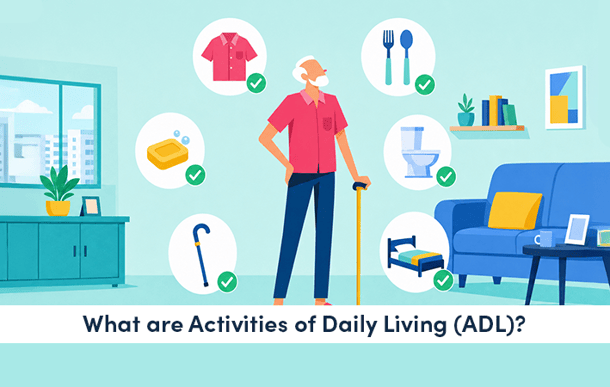
Activities of daily living (ADLs) are the basic self-care tasks you need to manage everyday life, such as washing, dressing, eating and getting out of bed. When someone can't do several of these on their own, they usually need a caregiver's help.
In Singapore, ADLs matter beyond the clinic. Doctors and therapists use them to describe how independently someone is functioning, and national schemes like CareShield Life use them to decide who qualifies for long-term care payouts. Many life insurance policies also use ADLs to define disability.
This guide explains the 6 ADLs used in Singapore, how they differ from instrumental ADLs (IADLs), why some sources list more than six, and how ADLs show up in assessments and insurance.
What Are the 6 Activities of Daily Living in Singapore?
Singapore's six ADLs come from the definitions used by CareShield Life and ElderShield, the national long-term care insurance schemes overseen by the Ministry of Health (MOH) and administered by the CPF Board. Most local insurers use the same six, although the exact wording can differ.
ADL | What it means | Everyday example |
Washing | Washing in the bath or shower, including getting in and out, or washing by other means | Showering and washing your hair without someone doing it for you |
Dressing | Putting on, taking off, securing and unfastening all clothes, plus any braces, artificial limbs or other medical appliances | Putting on a shirt and trousers and doing up the buttons or zip |
Feeding | Feeding yourself once food has been prepared and made available | Using a spoon or adapted cutlery to eat a meal on your own |
Toileting | Using the toilet, or managing bowel and bladder function with diapers or other protective aids | Getting on and off the toilet and cleaning yourself |
Walking or moving around | Moving indoors from room to room on level surfaces | Walking from the bedroom to the kitchen, with or without a walking stick |
Transferring | Moving from a bed to an upright chair or wheelchair, and back again | Getting out of bed and into a wheelchair without being lifted |
Some documents use different labels, such as "mobility" instead of "walking or moving around". The underlying abilities are the same, but the exact definition in your scheme or policy is what counts when you make a claim.
These six tasks are usually assessed together. Under CareShield Life and ElderShield, being unable to perform at least 3 of the 6 is the threshold for severe disability, which triggers monthly payouts. MOH has explained that targeting severe disability, where care needs and costs are highest, keeps premiums affordable for everyone.
Basic ADLs vs Instrumental ADLs (IADLs)
Basic ADLs cover physical self-care. Instrumental activities of daily living (IADLs) are the more complex tasks you need to live independently in the community. MOH describes them as activities that require higher cognitive functions, such as communicating with others and managing your finances.
Someone can manage every basic ADL and still struggle with IADLs. An elderly parent may bathe and dress without help, for instance, but start missing bill payments or doses of medication. Changes like these are often the first signs that someone needs more support at home.
Here are the IADLs you're most likely to see on assessment forms:
IADL | What it covers | Everyday example |
Managing finances | Handling day-to-day money matters | Paying household bills on time |
Shopping | Buying essentials in store or online | Buying groceries and toiletries from a list |
Preparing meals | Planning and cooking simple meals safely | Cooking a basic dish on the stove |
Housework and laundry | Keeping the home clean and managing clothes | Sweeping the floor and washing, drying and folding clothes |
Managing medication | Taking prescribed medicine correctly | Taking the right pills at the right time and getting refills |
Using transport | Getting around outside the home | Taking the MRT or booking a private-hire ride |
Using the phone or digital tools | Communicating and accessing services | Calling family or using an app to book a clinic appointment |
Why IADLs don't count towards scheme claims
National long-term care schemes, including CareShield Life, assess disability using basic ADLs only. In a 2021 parliamentary reply, MOH said this approach balances adequate support for severely disabled Singaporeans against keeping premiums affordable. MOH has also called ADL performance a sound, objective basis for broad schemes such as the Home Caregiving Grant.
IADLs still matter in practice. Hospital teams, home-care providers and social workers use them to plan rehabilitation, home help and community support.
Why Some Sources List More Than 6 ADLs
Search online and you'll find lists of 5, 7, 10, 12 or even 14 ADLs. There's no single global standard, because different assessment tools group or split the same everyday tasks depending on what they're used for.
Shorter lists bundle related tasks together, such as counting bathing and grooming as one item. Longer lists, common in hospitals, therapy and research, break tasks into smaller steps, such as separating walking from climbing stairs, so small changes are easier to track. For Singapore's national schemes and most local insurance policies, the six ADLs above are the ones that count.
How ADL and IADL Assessments Work
An ADL or IADL assessment records how independently someone manages each task, usually on a checklist or questionnaire. For each activity, the assessor typically notes whether the person can do it independently, needs some help or needs full help, and whether they rely on equipment such as a walking frame.
Who carries out the assessment depends on its purpose:
Hospital and rehabilitation teams record a baseline and track recovery after a stroke, fall or surgery.
Home-care and eldercare providers use it to decide what support someone needs and how often.
MOH-accredited severe disability assessors assess CareShield Life and ElderShield claims against the schemes' own ADL definitions.
Private insurers assess claims against the definitions in your policy contract, usually based on medical reports.
If you're caring for a parent, a simple log of what they can and can't manage, and under what conditions, makes conversations with doctors and social workers more concrete. These notes are useful, but only the official assessment counts for a scheme or insurance claim. Our guide on how to improve your chances of a successful insurance claim covers what else to prepare.
How ADLs Affect Insurance and Long-Term Care in Singapore
ADLs are most likely to affect your finances through national long-term care schemes and private insurance policies.
CareShield Life and ElderShield
CareShield Life, launched in October 2020, is Singapore's national long-term care insurance scheme and succeeds the older ElderShield scheme. Both pay a monthly cash payout if an MOH-accredited assessor finds you can't perform at least 3 of the 6 ADLs. Under CareShield Life, payouts continue for as long as you remain severely disabled.
CareShield Life supplements
Private insurers sell CareShield Life supplements that can pay out at lower levels of disability. Depending on the plan, payouts or extra benefits can start when you can't perform just 1 or 2 ADLs, instead of the 3 that CareShield Life requires. MOH points to these supplements if you want cover for mild or moderate disability.
Total and permanent disability (TPD) in life insurance
Many whole life and term plans include a total and permanent disability (TPD) benefit. Before a set age, often 65, TPD usually means you can't work at all. After that age, or if you weren't working when the disability started, many policies switch to an ADL test, commonly being unable to perform at least 3 of 6 ADLs.
There's no single TPD definition across insurers. When you compare whole life or term life plans on MoneySmart, check each plan's product summary for:
The age at which the ADL test applies, and when TPD cover ends
Whether an ADL counts as failed only if you can't do it even with aids
How long the disability must last before the insurer pays
Our life insurance guide explains how TPD fits alongside death and terminal illness cover. Keep in mind that official scheme definitions and your actual policy wording always take priority over a general guide like this one, which isn't a medical assessment or personalised financial advice.

 Why Buy Through MoneySmart?