Key Takeaways
Travel insurance coverage for lost, delayed, or damaged luggage typically ranges between $3,000 to $5,000 and up to $10,000 for some higher-tier plans.
Sub-limits apply to valuables like jewellery, electronics, and travel documents (often between $200 and $1,000 per item), so review your policy details carefully.
Always report problems at the airline counter, keep your Property Irregularity Report (PIR), save all receipts, and take clear photos to support your claim.
There’s an important difference between lost or damaged luggage (which covers the value of missing or destroyed items) and delayed luggage (which reimburses you for emergency purchases, usually $100–$200 for every 6 hours of delay).
Common exclusions include unattended bags, normal wear and tear, and items above specific per-item limits. Know what your plan does not cover.
Every year, thousands of travellers face lost, delayed, or damaged luggage, which disrupts trips and causes unexpected expenses. While airlines may offer basic compensation, it often falls short of covering real losses and inconvenience.
Travel insurance for luggage offers critical financial protection against these common mishaps like these. Choosing the right travel insurance plan ensures you’re prepared for the unpredictable, reducing both stress and costs when things go wrong. With smart coverage, you can travel with greater peace of mind.
What is Covered Under Baggage Insurance?
Travel insurance for luggage typically falls into two main categories: loss or damage, and delay. Each provides a safety net for different types of baggage mishaps while you travel.
Coverage type | What’s covered | Typical payout / limit | How it’s calculated |
|---|
Loss / damage | Lost, stolen, or damaged luggage and contents | $3,000–$5,000 (some up to $10,000) | Based on value of missing/damaged items |
Delayed luggage | Bags arriving late at your destination | Around $1,000 (some up to $5,000) | Based on number of hours of delay, typically at a rate of $100–$200 for every 6 hours of delay |
Baggage loss or damage
This protects you if your checked-in or carry-on luggage is lost, stolen, or physically damaged while travelling. Claims are typically paid based on the actual value of items, factoring in depreciation and proof of ownership. Within this coverage, there are additional sub-limits for certain categories such as:
Travel documents: Policies often set a maximum claimable amount for the loss of passports, visas, and other essential documents.
Money: Only a small portion of cash lost with your luggage may be reimbursed, usually capped at a low limit.
Jewellery, laptops, and other valuables: These are also subject to specific sub-limits, often much lower than the total baggage coverage.
Baggage delay
If your bags are delayed upon arrival, baggage insurance helps cover the cost of emergency purchases—such as clothing, toiletries, or other essentials—while you wait. Most policies pay out a set amount for each 6-hour period of delay, often ranging from $100 to $200 per interval, up to a total limit. Receipts for your purchases are required when making a claim.
💡 MoneySmart Tip
Always check the sub-limits in your policy, especially for travel documents, cash, and high-value items. Keeping receipts and taking photos of your belongings before you travel can make claims much easier.
Which Travel Insurance Plans Cover Luggage Loss or Delay?
Virtually all travel insurance plans in Singapore include some level of cover for lost, damaged, or delayed luggage. However, each insurer sets its own coverage limits, payout methods, and unique features. The table below provides a snapshot of what you can expect from five major providers—helping you compare and find the right fit for your travel needs.
Comparing baggage coverage from top insurers
Insurer | Baggage delay claim limit | Baggage loss claim limit | Per item sub-limit for baggage loss | How to submit a claim |
|---|
MSIG | $600 – $1,500 ($150 – $250/6 hours) | $3,000 – $7,500 | $500 – $1,000 per item | Online portal |
Starr | $400 ($100/6 hours) | $3,000 – $7,500 | $400 per item | Online eClaims Service |
FWD | $150 – $900 ($150/6 hours) | $3,000 – $7,500 | $300 – $500 per item | Online portal |
Income | $1,000 – $2,000 ($200/6 hour) | $3,000 – $8,000 | $500 per item | Online portal |
Tiq | $200 (max $100/6 hours) | $2,000 – $3,000 | $250 per item | Online via TiqConnect, or via the Tiq by Etiqa App |
Here’s what you need to know about each component:
Baggage delay claim limit: The highest payout for delayed baggage, usually calculated in blocks (e.g., $200 per 6 hours).
Baggage loss claim limit: The upper limit you can claim if your luggage is lost or damaged.
Per item sub-limit for baggage loss: The maximum you can claim for one item versus your total claim per trip. Note this is a general limit; higher limits can apply to high-value items like laptops and jewellery.
How to submit a claim: Most insurers support digital claims; some offer claim apps.
Which insurer offers the fastest baggage claims?
In general, travel insurance providers process baggage claims using the same timelines and systems as other claims, such as travel delay or medical expenses. You should not expect baggage claims to be handled significantly faster or slower than other types of travel insurance claims.
That said, some insurers offer unique features for greater convenience. For example, Tiq lets you receive instant payment via PayNow for certain claims, and you can even get paid automatically for a flight delay of three hours or more with no claim submission required.
💡 MoneySmart Tip
Use trusted online comparison tools like MoneySmart's travel insurance comparison to explore coverage limits, premiums, and policy features across leading insurers in Singapore—helping you find the right insurance plan for your trip, quickly.
What To Do If Your Luggage Is Lost, Delayed, or Damaged?
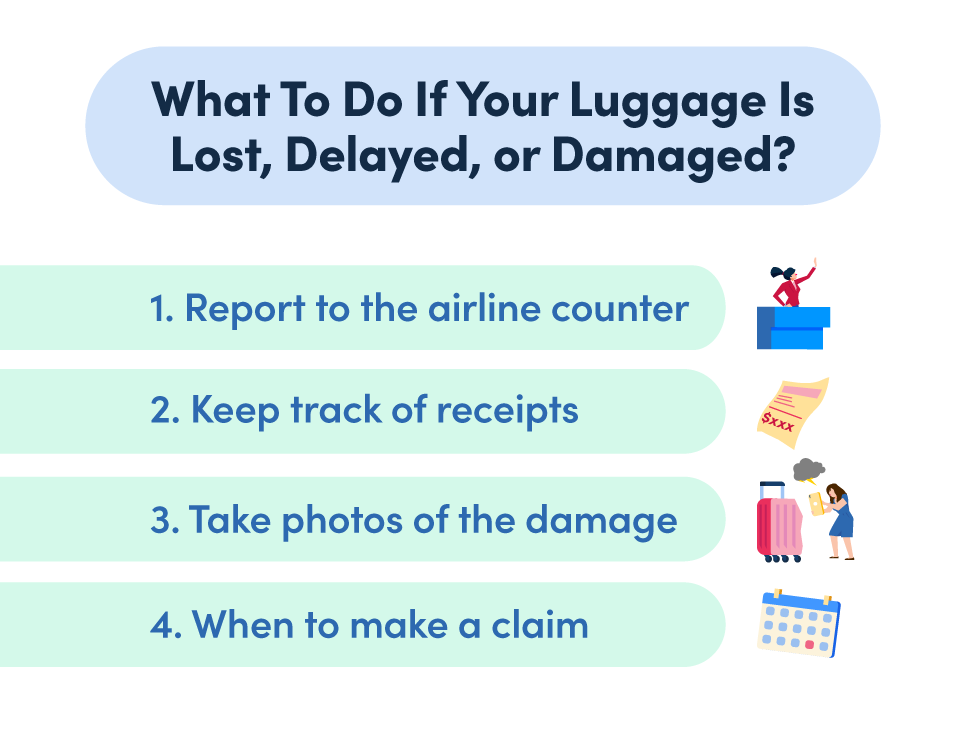
If your travel luggage goes missing, arrives late, or is damaged, it’s important to act quickly and follow the right steps. This not only increases your chances of recovering your items, but also helps ensure a smooth travel insurance claim.
Report to the airline counter
Notify the airline or ground staff as soon as you notice your baggage is missing or damaged. They will issue a Property Irregularity Report (PIR), which is a required document for most travel insurance claims.
Keep track of receipts
Save all receipts for any emergency purchases you make while waiting for your luggage, such as toiletries or clothing. These are essential for claiming under travel insurance for delayed luggage.
Take photos of the damage
If your luggage or belongings are damaged, take clear photos as soon as possible. Photo evidence helps substantiate your claim and may speed up the process.
When to make a claim?
Submit your travel insurance claim as soon as you have all the required documents, which typically include the PIR, proof of delay or loss, photos, and receipts. Most insurers require claims to be made within a set period after the incident, such as within 30 days. As a best practice, it’s prudent to submit your claim as soon as you can.
What is Not Covered Under Baggage Insurance?
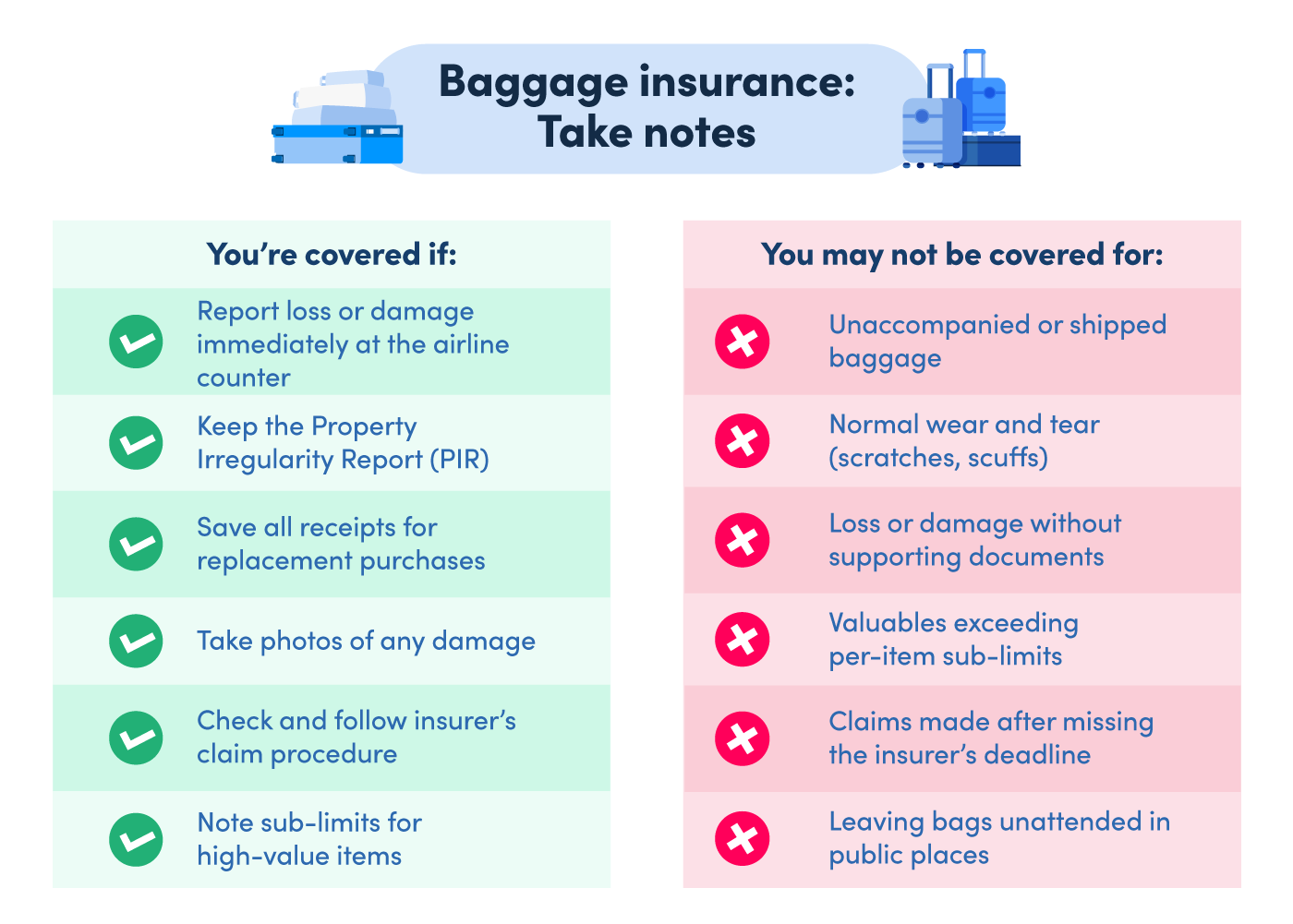
Travel insurance for luggage is comprehensive, but there are important exclusions and common misconceptions to be aware of:
Unaccompanied baggage is not covered. If your bags are shipped separately or left unattended, claims for loss or damage are likely to be rejected.
Ordinary wear and tear is excluded. Scratches, scuffs, or minor damage from regular use are not covered by travel insurance.
High-value items such as jewellery, electronics, laptops, and watches are subject to strict sub-limits, often much lower than the overall baggage coverage. Check your policy for specific caps.
Missing documentation can result in denied claims. You must provide required documents such as a Property Irregularity Report (PIR), receipts for expenses, photos of the damage, and official airline reports. Without these, insurers may not process your claim.
💡 MoneySmart Tip
Review your policy’s exclusions and sub-limits before travelling. When in doubt, carry valuables in your hand luggage and always keep documentation in order.


 Why Trust MoneySmart?
