Key Takeaways
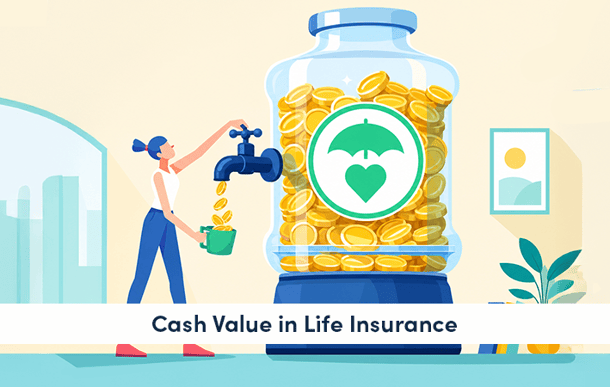
Cash value is the savings portion of Singapore whole life plans and investment-linked policies (ILPs), accessible while you're alive and separate from the death benefit paid to your beneficiaries.
Cash value grows slowly at first, since early premiums mostly cover fees, then compounds faster the longer the policy stays active.
Surrendering your policy early isn't the same as withdrawing its cash value; charges and any outstanding loans get deducted first, often leaving you with less than you've paid in.
Withdrawals, policy loans, and full surrenders all shrink the protection and payout your beneficiaries would otherwise receive.
Term life insurance builds no cash value at all, so compare whole life plans and ILPs in Singapore if you want lifelong coverage with a savings component.
"Cash value" is the savings component within Singapore life insurance policies such as whole life plans or ILPs.
It's designed for you, the policyholder, to access while alive, whether through a withdrawal, a policy loan, or by paying future premiums, unlike the death benefit (or "face value"), which only pays out to your beneficiaries. Accessing your cash value, however, reduces the payout they eventually receive.
Cash value: The savings fund within your policy, built up through premiums and accessible or borrowable while you're alive.
Surrender value: What you'd receive if you end ("surrender") your policy early—usually the cash value minus charges and deductions.
Face value (death benefit): The lump sum promised to your beneficiaries upon your death, excluding bonuses unless specified.
Confusing these three terms can distort your expectations about withdrawable funds versus insurance protection, so it's worth keeping them straight before you buy or manage a policy.
How Does Cash Value Accumulate Over Time?
Every premium splits between insurance protection and your cash value account.
Early on, most of it covers administrative charges, cost of insurance, and commissions. But as the policy matures, a shrinking share goes to fees and more stays invested in the insurer's fund:
Assuming a whole life policy, $2,000 annual premiums:
Year | Total premiums paid | Cash value | Cash value as % of premiums |
|---|
1 | $2,000 | ~$0 | ~0% |
5 | $10,000 | ~$3,000 | ~30% |
10 | $20,000 | ~$12,000 | ~60% |
20 | $40,000 | Can exceed $40,000 | 100%+ possible |
Disclaimer: Indicative only, actual growth depends on your plan, insurer, and declared bonus rates.
Growth speed depends on:
Premium amount and frequency: Higher or more frequent premiums build cash value faster
Bonus / dividend rates: Insurer-declared and not guaranteed, so they can vary year to year
Policy fees: Higher charges slow early accumulation
Policy duration: The longer you keep the policy, the more time it has to compound
Types of Life Insurance with Cash Value
Not every life insurance plan builds cash value—here's how the main types compare, and why term life doesn't.
Whole life insurance
Whole life insurance offers lifetime coverage with fixed premiums. Cash value builds slowly, often starting from year 2–3, and suits those who want certainty over faster early growth.
Investment-linked policies (ILPs)
Investment-linked policies (ILPs) channel your premiums into sub-funds of your choice—equities, bonds, or a mix—so cash value and death benefit rise and fall with market performance instead of a guaranteed rate. This is Singapore's main market-linked alternative to whole life plans (similar to what's called "universal life" or "VUL" elsewhere).
Term life insurance
Term life insurance, by contrast, is pure protection with no savings component: no cash value accumulates, which is why it's far cheaper but offers no living benefit.
Policy type | Cash value grows? | Flexibility | Risk level |
|---|
Whole life (participating / non-participating) | Yes (guaranteed / bonuses) | Low | Low |
Investment-linked policy (ILP) | Yes (market-linked) | High | Moderate–high |
Term life | No | N/A | N/A |
How to access or withdraw your cash value?
Partial withdrawal: Submit a request with your NRIC and policy details; processing timelines vary by insurer. This reduces future bonuses and your final payout, and some plans require a minimum balance.
Policy loan: Borrow against your cash value. Insurers typically cap this at up to 90%, with interest rates set by each insurer and accruing over time. Unpaid interest erodes your policy's value; if the loan plus interest exceeds your surrender value, the policy can lapse.
Full surrender: Submit a surrender form; the insurer pays out your surrender value, with processing timelines varying by insurer. Once surrendered, you lose all protection permanently and cannot reinstate on the same terms.
Do note that two MAS guidelines apply regardless of method:
Insurers are required to disclose all fees and surrender values upfront
Every life policy includes a free-look period (typically 14 days) to cancel, subject to standard deductions like medical or admin fees.
Beyond that, any withdrawal or loan permanently lowers the protection your policy offers—so weigh the trade-off against your actual need for the funds.
Pros and Cons of Cash Value Life Insurance
Cash value life insurance offers a mix of protection and savings, with distinct trade-offs for Singapore residents.
Pros ✅ | Cons ❌ |
|---|
Lifelong coverage, not just a fixed term | Significantly higher premium costs than term life, for the same coverage |
Forced savings discipline in the form of premiums building a long-term savings pot automatically | Most early premiums go to fees, leaving little cash value accumulating at first |
Potential tax advantages because most life insurance payouts in Singapore are tax-free | Lower returns than alternatives; funds grow slower than CPF, fixed deposits, or unit trusts |
Partial funds withdrawals or policy loans while you're alive | Bonus structures, surrender charges, and loan provisions can be hard to follow |
No market loss risk under participating whole life plans; guaranteed benefits offer stability | CPF not usable for premiums on most cash value plans. |
Legacy and estate planning, useful for wealth transfer | Less coverage per dollar than term insurance, which offers no cash value. |

 Why Buy Through MoneySmart?